What Is the Difference Between Eyelid Surgery and Non-Surgical Treatments?
Eyelid surgery, or blepharoplasty, structurally and permanently removes or repositions excess skin, muscle, and fat around the eyes. Non-surgical treatments temporarily address surface texture, dynamic expression lines, and localized volume loss without removing tissue. The right choice depends on whether your concern is caused by structural changes, superficial changes, or both.
The eyes are often the first feature to show visible signs of aging. Because the skin surrounding the eyelids is the thinnest on the human body, it is exceptionally vulnerable to loss of elasticity, sun exposure, and structural shifts. When patients visit my practice in the SF Bay Area seeking to refresh their appearance, our discussion centers on identifying the root cause of their aesthetic concerns: is the issue structural, superficial, or a combination of both?
Understanding the fundamental difference between surgical blepharoplasty and non-surgical modalities begins with anatomy.
Surgical Blepharoplasty: Structural Correction
Eyelid surgery, clinically known as blepharoplasty, is a definitive surgical procedure designed to correct structural changes in the peri-orbital region. It is divided into upper and lower procedures:
- Upper Blepharoplasty: Focuses on removing redundant, hanging skin (dermatochalasis), tightening underlying muscle fibers, and occasionally removing or repositioning small amounts of herniated fat. When upper eyelid skin sags heavily over the natural crease, blepharoplasty restores a well-defined lid platform and can eliminate visual field obstruction.
- Lower Blepharoplasty: Targets prominent under-eye bags and puffiness. This is achieved by carefully repositioning or trimming herniated orbital fat pads, tightening lax supportive tendons, and smoothing redundant skin beneath the lash line.
Because blepharoplasty directly alters anatomical structures, it delivers permanent changes to the tissues that create tired-looking eyes.
Non-Surgical Treatments: Surface and Volume Refinement
Non-surgical treatments do not remove excess tissue or alter deep structural anatomy. Instead, they manipulate muscle movement, replace lost facial volume, or stimulate the skin surface:
- Neuromodulators (Botox): Temporarily relax specific muscle groups around the eyes, softening dynamic expression lines like crow's feet and providing a subtle lateral brow elevation.
- Dermal Fillers: Hyaluronic acid gels placed along the tear trough or infraorbital rim blend the transition between the lower eyelid and upper cheek, disguising hollows or shallow shadow lines.
- Laser Skin Resurfacing and Chemical Peels: Remove damaged outer skin layers to encourage smoother surface texture, soften fine lines, and reduce sun spots.
- Radiofrequency and Ultrasound Energy: Deliver controlled thermal energy into the dermis to encourage skin contraction and support mild tissue tightening.
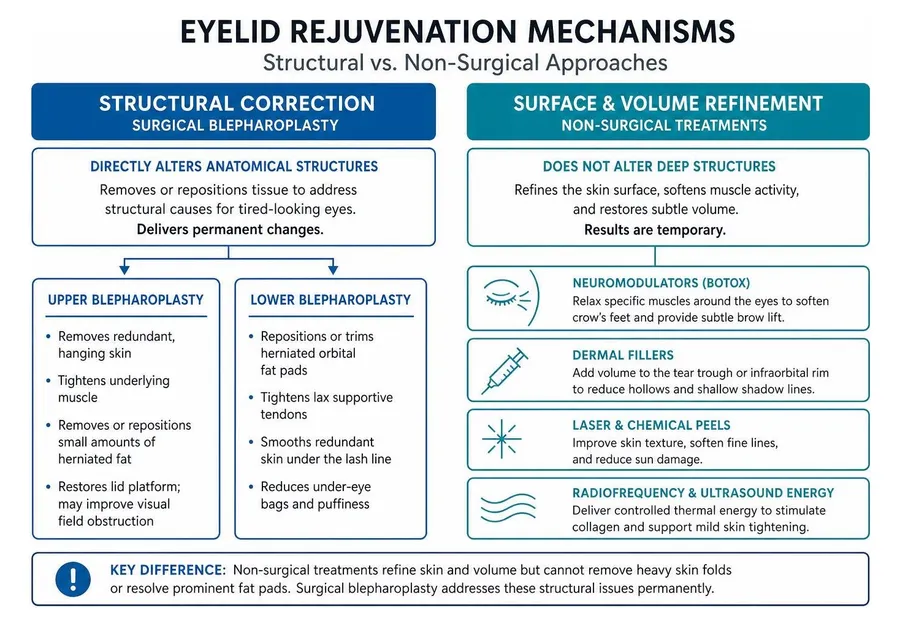
While non-surgical treatments excel at refining skin texture and restoring subtle mid-face volume, they cannot eliminate heavy skin folds or resolve prominent fat pads. Choosing the correct path requires matching your specific anatomic concerns to the capability of each treatment modality.
Which Concerns Are Best Treated Surgically vs. Non-Surgically?
Patients frequently ask whether an injectable or laser treatment can replace surgery. The answer depends entirely on the specific tissue changes causing the aesthetic concern.
Concerns Requiring Surgical Blepharoplasty
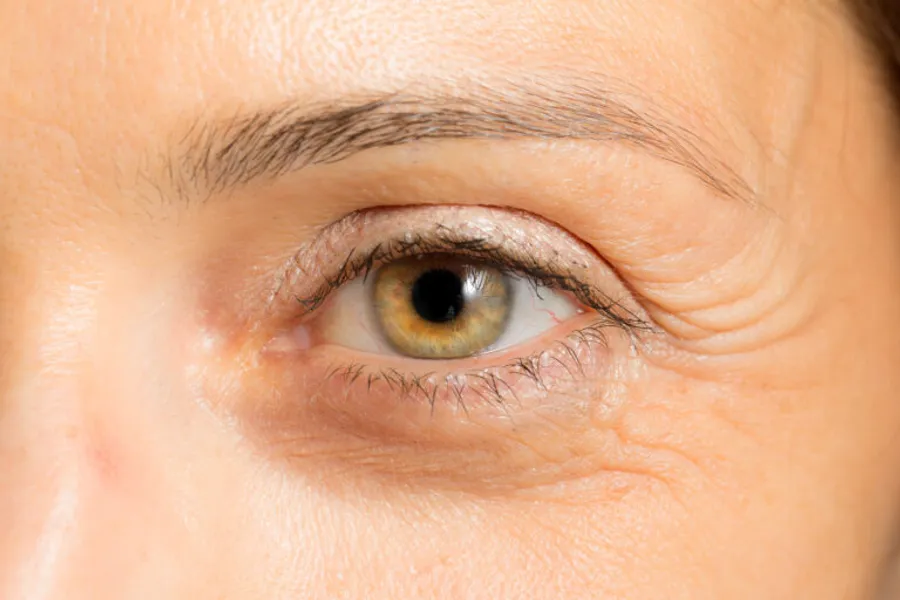
When the primary issue is excess tissue or displaced anatomical fat, surgical intervention is the only definitive solution:
- Heavy Upper Eyelid Hooding: When skin loses elasticity and folds over the eyelashes, energy devices and neurotoxins cannot tighten the skin sufficiently to clear the excess. Only surgical excision creates a crisp, open eyelid contour.
- Prominent Under-Eye Bags: Under-eye puffiness is typically caused by the herniation of normal orbital fat forward against weakened connective tissue. Fillers placed over large fat pads often make the lower lid look bulkier. Surgically repositioning or removing this fat creates a smooth lower lid contour.
- Impaired Peripheral Vision: When hanging upper lid skin drapes over the visual axis, blepharoplasty physically lifts the obstruction, restoring both appearance and visual function.
- Lower Lid Laxity: When the lower eyelid sags away from the eyeball, surgical tightening of the supporting tendons is necessary to support proper eye protection and position.
Concerns Well-Suited for Non-Surgical Treatments
Non-surgical treatments shine when the issue relates to dynamic muscle movement, localized volume loss, or surface texture:
- Dynamic Crow's Feet: The fine expression lines fanning out from the corners of the eyes occur due to the contraction of the orbicularis oculi muscle. Neuromodulators effectively relax these fibers, smoothing the skin during smiles and expressions.
- Tear Trough Hollows Without Fat Bags: If you have dark shadows caused by an inherited hollow groove beneath the eyes, but your skin is firm and there are no protruding fat pads, carefully placed tear trough filler can blend the lid-cheek junction smoothly.
- Superficial Crepiness and Fine Wrinkles: Fine, paper-thin crinkling of the peri-orbital skin responds well to fractional laser resurfacing or targeted chemical peels that smooth the dermal layer.
- Mild Brow Descent: A strategically placed neuromodulator can lift the tail of the eyebrow slightly, creating a refreshed look for patients with minimal tissue laxity.
Primary Peri-Orbital Concerns and Recommended Pathways
- Excess, folding upper eyelid skin: Upper Blepharoplasty
- Prominent under-eye puffiness or fat pads: Lower Blepharoplasty
- Deep tear trough groove with good skin tone: Dermal Fillers
- Dynamic expression lines and crow's feet: Neuromodulators (Botox)
- Fine surface texture irregularities and sun damage: Fractional Laser Resurfacing
- Combined excess skin with surface crepiness: Blepharoplasty paired with Laser Resurfacing
How Do Longevity, Downtime, and Investment Compare?
When weighing surgical and non-surgical options, evaluating how each treatment fits into your life over time is critical. This includes comparing how long results endure, how much recovery time is required, and the cumulative investment of ongoing maintenance.
Longevity of Results
- Surgical Blepharoplasty: An upper or lower blepharoplasty delivers enduring structural correction. The excess skin and fat removed during surgery are gone permanently. While natural facial aging continues over the years, the clock is turned back significantly, and most patients enjoy their surgical results for a decade or longer without needing a repeat operation.
- Non-Surgical Treatments: Non-surgical options offer temporary results because the body naturally metabolizes injectables, and skin continues to loosen without structural repositioning. Neuromodulators typically last three to four months. Tear trough fillers generally last nine to eighteen months. Energy-based skin tightening and laser resurfacing often require maintenance sessions every one to two years to sustain improvements.
Downtime and Recovery Windows
- Blepharoplasty Downtime: Surgical eyelid rejuvenation requires a dedicated recovery window. Most patients take one to two weeks away from work and social commitments to allow initial swelling and bruising to subside. Suture removal occurs within five to seven days, after which light makeup can be applied to camouflage residual discoloration.
- Non-Surgical Downtime: Injectables involve virtually zero downtime, allowing patients to return to daily routines immediately, with only mild swelling or minor pinprick bruising. Fractional laser resurfacing may involve three to seven days of redness and skin flaking, but the recovery remains minimal compared to surgery.
Evaluating Value and Long-Term Planning
When patients begin exploring facial rejuvenation, understanding eyelid lift costs helps contextualize surgery as a single investment with long-lasting benefits. While the initial commitment for surgery is higher than a single syringe of filler or a neuromodulator treatment, non-surgical modalities require ongoing appointments several times a year to maintain results. Over a five to ten year span, the cumulative financial and time investment of recurring non-surgical treatments can rival or exceed the investment in a one-time surgical procedure that delivers more profound structural change.
| Feature | Surgical Blepharoplasty | Non-Surgical Rejuvenation |
|---|---|---|
| Primary Mechanism | Surgical removal/repositioning of skin, muscle, and fat | Muscle relaxation, dermal filling, surface resurfacing |
| Best For | Heavy hooding, prominent fat bags, redundant skin | Dynamic lines, shallow hollows, surface texture |
| Typical Longevity | Ten or more years | Three to eighteen months (modality dependent) |
| Initial Downtime | Seven to fourteen days | Minimal (zero to several days for lasers) |
| Maintenance | Minimal long-term surgical maintenance | Regular touch-up sessions required |
| Result Magnitude | Definitive structural restoration | Subtle to moderate refinement |
What Does the Recovery Process Look Like for Each Option?
A clear understanding of the recovery process helps patients prepare their schedules and set realistic expectations for the healing journey.
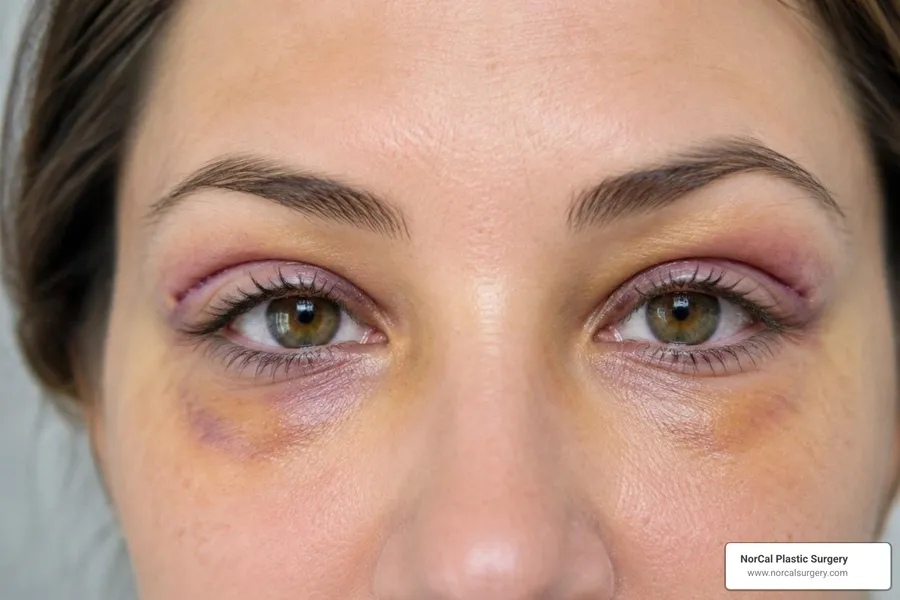
Surgical Blepharoplasty Recovery Milestones
Surgical recovery is a gradual, predictable process. Because the peri-orbital tissues are delicate, swelling and bruising are normal responses to tissue manipulation:
- Days 1 to 3: Swelling and bruising reach their peak. Patients apply cold compresses to the eyes and rest with their head elevated on extra pillows to assist lymphatic drainage. Discomfort is generally mild and managed easily with prescribed or over-the-counter medication.
- Days 5 to 7: Suture removal takes place in our clinic. By this time, bruising begins shifting from deep purple to lighter yellow and green tones. Many patients feel comfortable working from home and managing basic tasks.
- Days 10 to 14: Most bruising resolves, and residual swelling becomes subtle to casual observers. Patients typically feel confident returning to social outings, work, and light walking exercise. Camouflage makeup can be worn safely over healed incisions.
- Weeks 4 to 8: Incision lines continue to soften, flatten, and fade into the natural contours of the eyelids. Tissues settle into their refined, natural positions.
Surgical Post-Operative Care Guidelines
To ensure optimal healing after eyelid surgery, I guide my patients through straightforward post-operative practices:
- Keep the head elevated at all times, including during sleep, for the first week.
- Use clean cold compresses regularly during the first forty-eight hours to manage tissue swelling.
- Avoid strenuous workouts, heavy lifting, and bending forward for two weeks to prevent elevated blood pressure around the eyes.
- Wear dark sunglasses outdoors to protect delicate healing tissues from sun and wind sensitivity.
- Refrain from wearing contact lenses for approximately two weeks until eyelid closure feels completely comfortable.
Non-Surgical Recovery Expectations
Non-surgical treatments involve a very gentle recovery profile:
- Neuromodulators: Injections take less than twenty minutes. Patients may experience small red bumps at the injection sites that fade within an hour. Normal daily activities can be resumed immediately, though I advise avoiding vigorous exercise and lying flat for four hours post-treatment.
- Dermal Fillers: Mild swelling and localized bruising can occur around the delicate under-eye area, usually resolving within three to five days. Applying ice intermittently after treatment helps minimize swelling.
- Laser Resurfacing: The skin feels warm and appears red for several days, resembling a mild sunburn. Patients keep the area moisturized with gentle ointments and avoid direct sun exposure until the skin surface fully heals.
Safety and Potential Complications
All medical procedures carry inherent considerations. In blepharoplasty, potential side effects include temporary dry eye symptoms, minor asymmetry during early healing, or prolonged swelling, which are carefully managed through surgical technique and structured follow-up. For non-surgical treatments, potential risks include minor bruising, temporary eyelid or brow heaviness if neurotoxins diffuse, or filler placement irregularities that require dissolution with hyaluronidase. Choosing a qualified, board-certified plastic surgeon ensures that treatments are performed with anatomical precision and the highest safety standards.
How Do You Choose the Best Eyelid Treatment for Your Needs?
Selecting between eyelid surgery and non-surgical rejuvenation is not a one-size-fits-all decision. During your consultation, we evaluate several key factors to build a personalized treatment plan tailored to your facial anatomy.
1. Underlying Facial Anatomy
Your unique bone structure, eyelid position, and skin elasticity form the foundation of our recommendation. If your main concern is caused by true tissue excess or orbital fat protrusion, attempting non-surgical fixes often leads to underwhelming results. Conversely, if your anatomy shows youthful skin elasticity with localized volume loss along the cheek junction, a non-surgical approach can provide an elegant enhancement.
2. Lifestyle and Downtime Availability
Your daily commitments play a role in timing and technique selection. If your schedule allows for a one-to-two-week recovery window, surgical blepharoplasty provides a definitive correction that frees you from recurring appointments. If you need a rapid return to work with zero visible downtime, starting with targeted injectables or gentle skin treatments may better align with your immediate lifestyle.
3. Personal Aesthetic Goals
Consider the magnitude of transformation you desire. Are you looking to soften expression lines around your eyes when you smile, or do you want to eliminate the heavy, tired appearance caused by sagging skin? Non-surgical treatments offer subtle, incremental refinements, while surgical blepharoplasty creates a profound, refreshed transformation that restores an alert and youthful eye contour.
4. The Power of Comprehensive Combination Approaches
In many instances, the most harmonious, natural results do not come from choosing strictly between surgery and non-surgical treatments, but from pairing them thoughtfully.
For example, performing an upper or lower blepharoplasty physically removes redundant skin and fat bags, while complementary fractional laser resurfacing or neuromodulators smooth fine surface crinkling and dynamic crow's feet. By combining the structural benefits of surgery with the surface-refining benefits of non-surgical care, we achieve a balanced, natural result that enhances your entire upper face.
At NorCal Plastic Surgery, I work closely with patients across the SF Bay Area, providing comprehensive evaluations at our fully accredited surgical facility in Tiburon as well as our Walnut Creek location, ensuring your treatment plan is matched precisely to your goals.
What Are the Most Frequently Asked Questions About Eyelid Rejuvenation?
Can Non-Surgical Treatments Lift Heavily Hooded Eyelids?
Non-surgical treatments cannot lift heavily hooded upper eyelids. While neuromodulators can relax the muscles pulling down on the outer brow to produce a subtle lift of one to two millimeters, they cannot remove or tighten significant amounts of redundant skin. Energy-based skin tightening devices also have strict safety limitations when applied near the delicate eyelid margin. When loose skin drapes over the natural eyelid crease or impedes vision, upper blepharoplasty remains the standard and most reliable solution.
How Long Do Blepharoplasty Results Typically Last?
The structural results of blepharoplasty are exceptionally long-lasting, with most patients enjoying their refreshed appearance for ten years or more. Because the excess skin, lax muscle, and protruding fat pads are permanently excised or repositioned, those specific tissues do not return. While your skin will continue its natural aging process over time, your eyes will consistently look more rested and youthful than they would have without the procedure.
Can You Combine Surgical Blepharoplasty with Non-Surgical Treatments?
Yes, combining surgical and non-surgical modalities is one of the most effective strategies for comprehensive facial rejuvenation. Surgical blepharoplasty addresses deep structural issues by removing excess skin and repositioning fat pockets, while non-surgical treatments like neuromodulators, dermal fillers, and laser skin resurfacing address dynamic muscle lines, mid-face volume loss, and surface skin texture. Combining these approaches delivers a harmonious, natural look that addresses all layers of facial aging.
What Is the Best Path Forward for Your Eyelid Goals?
The eyes are the central focus of personal communication, conveying vitality, emotion, and energy. When heavy eyelids, under-eye puffiness, or deep hollows make you appear fatigued despite feeling rested, choosing the right rejuvenation path can restore an alert, youthful appearance.
The core distinction between eyelid surgery and non-surgical treatments comes down to structure versus surface. Surgical blepharoplasty physically corrects redundant skin, lax muscles, and protruding fat pads with enduring results. Non-surgical modalities offer excellent temporary refinement for dynamic expression lines, minor volume depletion, and superficial skin texture with minimal downtime.
The most reliable way to determine the right path for your eyes is through an in-depth anatomical assessment. I invite you to schedule a private consultation with me at NorCal Plastic Surgery. Whether visiting our fully accredited surgical facility in Tiburon or our Walnut Creek office, we will review your anatomy, discuss your aesthetic goals, and create a customized treatment plan designed for natural, enduring results.