If you want to know how to lose weight without having sagging skin, the short answer is: slow down, build muscle, and feed your skin the nutrients it needs to keep up.
Here is a quick overview of what actually works:
- Lose weight gradually — aim for 1 to 2 pounds per week maximum
- Strength train at least 2 to 3 times per week to build muscle underneath the skin
- Eat enough protein — target 1.2 to 1.6 grams per kilogram of body weight daily
- Stay hydrated — drink at least 64 ounces of water per day
- Protect your skin from UV damage with SPF 30 or higher daily
- Avoid smoking and excess alcohol — both break down collagen faster
- Give your skin time — natural retraction continues for 12 to 24 months after weight stabilizes
These steps will not eliminate loose skin after major weight loss, but they can significantly reduce how much you end up with.
Losing weight is a real achievement. But for many women, especially those juggling busy lives and the physical changes that come with pregnancy or hormonal shifts, the arrival of loose or sagging skin can take the shine off that hard-won progress. Your skin is a living organ. It stretches to make room as your body grows, but it does not always snap back when the weight comes off. How much it bounces back depends on your age, how fast you lose the weight, how long you carried the extra weight, and the condition of the collagen and elastin fibers in your skin.
Think of your skin like a rubber band that has been stretched around a thick book for months. When you finally remove the book, the band does not return to its original tight shape. The longer it was stretched, and the older the rubber, the less it snaps back. Your skin works the same way.
The good news is that many of the factors that drive loose skin are within your control, and this guide walks you through exactly what to do at every stage.
I'm Dr. Timothy Rankin, a board-certified plastic surgeon and Fellow of the American College of Surgeons based in the SF Bay Area, with specialized training in body contouring, facial rejuvenation, and mommy makeover procedures. My work with patients navigating how to lose weight without having sagging skin has shown me that the best outcomes come from a personalized approach that starts with prevention and ends with precision surgery when it is truly needed.
The Science of Skin Elasticity: How to Lose Weight Without Having Sagging Skin
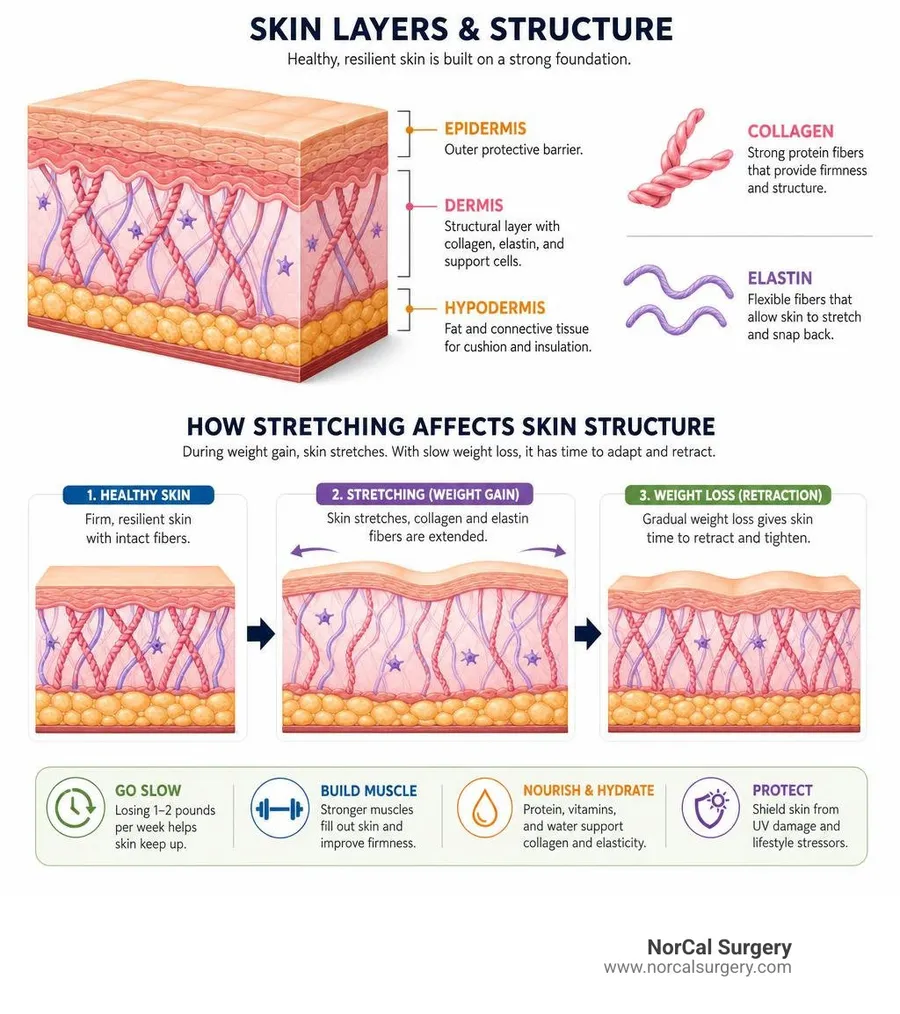
To understand how to keep your skin firm as you drop pounds, we have to look beneath the surface. Your skin is made of three primary layers: the epidermis (the outer barrier), the dermis (the structural powerhouse), and the hypodermis (the deep fat and connective tissue layer).
The dermis is where the magic happens. It is 15 to 40 times thicker than the epidermis and houses two vital proteins:
- Collagen: Making up about 75% of your skin's dry weight, collagen provides the structural framework and strength.
- Elastin: This protein gives your skin its "bounce back" ability, allowing it to stretch and return to its original shape.
When we gain weight, our skin stretches to accommodate the new tissue. However, human skin has a finite elastic limit, which is roughly 140% of its resting length. If your skin is stretched past this limit, or if it remains stretched for a prolonged period (such as years of carrying extra weight), those delicate elastin and collagen fibers stretch to their breaking point. Once broken, elastin fibers do not regenerate well in adults.
If you want to dive deeper into the clinical mechanics of this process, you can read more about this Evidence-based protocol on skin retraction.
Another key concept is skin turgor, which is the skin's ability to change shape and return to normal. When you lose fat quickly, you leave behind empty physical space in the hypodermis. If the dermis has lost its structural integrity, the skin simply hangs.
However, before you assume you have severe skin laxity, it is important to distinguish between true loose skin and stubborn subcutaneous fat. You can easily test this at home using a simple "pinch test."
| Feature | True Loose Skin | Stubborn Subcutaneous Fat |
|---|---|---|
| Thickness | Very thin, similar to the skin on the back of your hand. | Thick, substantial fold of tissue when pinched. |
| Texture | Crepey, wrinkled, or paper-like. | Smooth but soft, yielding, and plump. |
| Response to Pinch | Pulls away from the body effortlessly. | Feels heavy and remains attached to a deeper layer of fat. |
| Best Solution | Time, skin-tightening treatments, or surgical removal. | Continued gradual fat loss and strength training. |
Determining exactly what you are dealing with helps us target the right treatment, saving you time and frustration.
Pacing Your Progress: How to Lose Weight Without Having Sagging Skin Naturally
The absolute single best natural defense against sagging skin is controlling the speed of your weight loss. When you drop weight too quickly, your skin simply cannot keep up. Dermal remodeling, the process by which skin cells rebuild and contract, is a slow and steady biological mechanism. In fact, the natural collagen turnover rate in adult skin is only about 1% per day.
To give your skin the time it needs to remodel, we recommend following the CDC guidelines for weight loss: aiming for a gradual rate of 1 to 2 pounds per week.
According to clinical studies, patients who lose weight faster than 3 pounds per week experience a 61% rate of moderate-to-severe loose skin at the 12 month mark. Conversely, those who stick to a gradual pace of 1 to 2 pounds per week experience only an 18% rate of significant laxity.
By losing weight slowly, you allow collagen remodeling to occur concurrently with fat loss. For more practical advice on managing this journey, check out these Expert tips on avoiding saggy skin.
The GLP-1 Era: How to Lose Weight Without Having Sagging Skin on Medications
In 2026, weight loss medications like GLP-1 receptor agonists (including semaglutide and tirzepatide) have completely transformed metabolic medicine. Patients on these medications can achieve incredible results, often losing 15% to 21% of their total body weight. However, these medications introduce a unique challenge for your skin.
Because GLP-1 medications are highly effective, they often cause rapid weight loss that far exceeds the recommended 2 pounds per week. This rapid deflation outpaces the skin's natural contraction timeline, creating a temporary lag where skin looks significantly looser than it would during a slower weight loss phase.
Furthermore, rapid weight loss without proper intervention can lead to muscle catabolism. Without active physical resistance, up to 20% to 30% of the weight lost on GLP-1 medications can come from lean muscle mass rather than fat. When you lose muscle, you lose the firm structural foundation that pushes outward against your skin, making sagging look much worse.
To minimize this risk, we utilize a specialized Protocol for GLP-1 patients. This protocol emphasizes a slower titration speed (staying at lower doses longer to normalize the rate of weight loss) alongside targeted muscle preservation strategies.
The Prevention Protocol: Lifestyle and Nutrition Strategies
To help your skin adapt as your body changes, you need a proactive, daily protocol that supports your skin from the inside out.
1. Build Your Foundation with Resistance Training
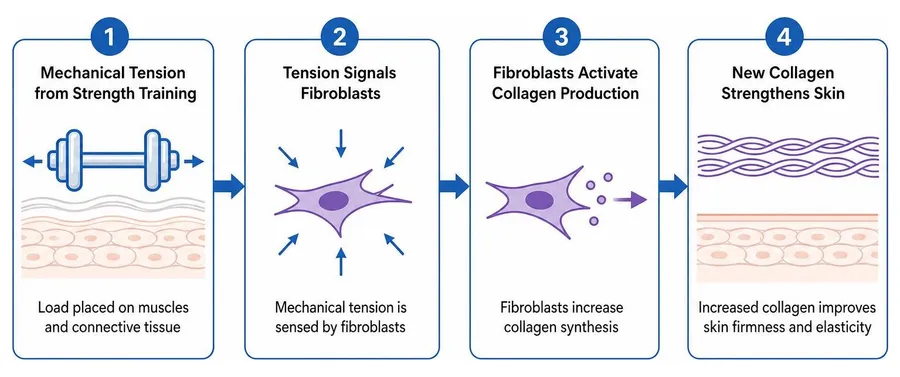
If there is one non-surgical intervention with solid clinical backing, it is progressive resistance training. When you lift weights, you build skeletal muscle in the hypodermis. This newly created muscle physically replaces the volume previously occupied by fat, acting as a natural "filler" to tauten the skin from beneath.
More importantly, resistance training creates mechanical tension. Dermal fibroblasts (the cells responsible for producing collagen and elastin) require this mechanical tension signal to trigger new collagen synthesis. A study demonstrated that progressive resistance training three times weekly for 16 weeks increased dermal thickness by 12% in the trained areas.
2. Prioritize High-Quality Protein and Micronutrients
Your body cannot build collagen without the proper raw materials. We recommend aiming for 1.2 to 1.5 grams of protein per kilogram of ideal body weight daily (and up to 1.6 to 2.2 grams per kilogram if you are actively lifting weights on a GLP-1 medication).
For a comprehensive breakdown of the nutrients that directly influence dermal remodeling, explore this Natural skin tightening protocol.
Focus on these key dietary building blocks:
- Amino Acids (Proline and Glycine): Found in bone broth, chicken, fish, and egg whites.
- Vitamin C: A mandatory co-factor for collagen synthesis. Without it, your body cannot cross-link collagen fibers. Enjoy citrus fruits, bell peppers, and broccoli.
- Zinc and Copper: Trace minerals that act as catalysts for skin repair and dermal remodeling. Found in nuts, seeds, shell fish, and whole grains.
3. Hydration, Sleep, and Cortisol Management
While drinking water does not magically shrink stretched skin, skin cells are 64% water. Proper hydration (aiming for at least 64 ounces or 2 liters daily) maintains skin turgor and overall cellular health.
Additionally, prioritize 7 to 9 hours of deep sleep. Growth hormone, which plays a massive role in tissue repair and collagen synthesis, is primarily released during deep sleep stages 3 and 4. Finally, manage your stress: elevated cortisol levels produce enzymes that actively degrade existing collagen fibers.
Non-Surgical Skin Tightening and Medspa Solutions
For patients experiencing mild to moderate skin laxity, modern medspa technologies offer excellent ways to boost collagen production without downtime. At NorCal Surgery, we design customized treatment combinations that target both the face and body.
Some of our most popular non-surgical options include:
- Radiofrequency (RF) Therapy: Devices like TempSure or Venus Legacy deliver controlled heat deep into the dermis. This heat immediately contracts existing collagen fibers and stimulates fibroblasts to produce new collagen over the next 3 to 6 months. Monopolar RF treatments show an average of 18% to 23% improvement in skin laxity.
- Ultrasound Skin Tightening: Utilizing high-intensity focused ultrasound (HIFU), this treatment targets deeper structural layers of the skin to lift and tighten areas like the neck, chin, and brow.
- RF Microneedling: Combining physical microneedles with radiofrequency energy, this treatment is highly effective for improving both skin texture and tightness on the abdomen, arms, and thighs.
To learn more about what we offer at our Bay Area locations, you can explore our resources on medspa body treatments and medspa face treatments.
A Note on the "Non-Surgical Mommy Makeover"
You may have heard the term "non-surgical mommy makeover" used in beauty circles. It is important to clarify that this is not a single, stand-alone medical procedure. Rather, it is shorthand for a highly customized combination of non-surgical body contouring, skin tightening, injectables, and wellness treatments.
While these combinations are fantastic for refining skin texture, reducing small pockets of stubborn fat, and boosting natural collagen, they are not equivalent to a surgical mommy makeover. Non-surgical treatments cannot repair separated abdominal muscles (diastasis recti) or remove large folds of excess skin.
Surgical Body Contouring: When Natural Methods Reach Their Limit
While lifestyle changes, nutrition, and medspa treatments work wonders for mild laxity, they have biological limits. If you have lost a significant amount of weight (typically 80 to 100 pounds or more), the elastic fibers in your skin have likely been stretched past their breaking point. In these cases, no amount of exercise or cream will fully restore tightness, and surgical skin removal becomes the most effective path forward.

At NorCal Surgery, Dr. Rankin specializes in state-of-the-art surgical body contouring procedures designed to restore your natural proportions with minimal, carefully placed scars:
- Abdominoplasty (Tummy Tuck): This procedure removes excess abdominal skin and tightens the underlying abdominal wall muscles that may have stretched during pregnancy or weight gain.
- Brachioplasty (Arm Lift): Removes the hanging "batwing" skin from the upper arms.
- Thigh Lift: Tightens and reshapes the inner and outer thighs by removing redundant skin.
- Breast Lift (Mastopexy): Restores a youthful shape and position to breasts that have lost volume and sagged after weight loss.
To explore these options further, view our detailed guides on surgical body contouring and surgical breast procedures.
Panniculectomy vs. Abdominoplasty
It is helpful to understand the difference between a functional panniculectomy and a cosmetic abdominoplasty. A panniculectomy is a reconstructive surgery designed solely to remove a hanging "apron" of skin and fat (the pannus) that causes medical issues like chronic rashes, hygiene challenges, or mobility restrictions.
An abdominoplasty, on the other hand, is a comprehensive cosmetic procedure that not only removes the excess skin but also tightens the abdominal muscles and sculpts the waistline for a more athletic contour. For a deeper look into life after major weight loss, you can read this comprehensive Guide to loose skin after weight loss.
The Golden Rule: Weight Stability
If you are considering surgical body contouring, timing is everything. We require patients to maintain a stable target weight for at least 6 to 12 months (and ideally wait 12 to 24 months post-weight loss) before undergoing surgery.
Your skin continues to naturally contract and remodel for up to two years after your weight stabilizes. Operating too early, while your body is still in a transitional phase, can compromise your long-term aesthetic results.
Frequently Asked Questions About Loose Skin
Can loose skin go away on its own after weight loss?
Yes, but only to a certain degree. Mild loose skin resulting from moderate weight loss (under 30 to 50 pounds) can contract naturally over a 12 to 24 month period after your weight stabilizes. However, your skin's natural retraction capacity depends heavily on your age, genetics, tobacco use, and how long the skin was kept under tension. For major weight loss of 80 to 100+ pounds, the skin's elastic limit has usually been exceeded, meaning surgery is typically required for complete correction.
Do collagen supplements actually help tighten loose skin?
The scientific evidence is modest. When you consume oral hydrolyzed collagen, your digestive system breaks those proteins down into basic amino acids (like glycine and proline). Your body does not automatically send those amino acids directly to your skin; instead, it distributes them wherever protein synthesis is needed most.
While daily supplementation of 10 to 15 grams of high-quality collagen peptides can modestly improve skin hydration and elasticity (by about 7% to 12%), it is far more effective to focus on hitting your overall daily protein target from whole food sources.
How does age affect skin elasticity during weight loss?
Age is a primary factor in how well your skin bounces back. Starting around age 20 to 30, natural collagen production declines by approximately 1% to 1.5% every single year. As we age, fibroblast activity slows down, and the dermis becomes thinner and less resilient. This is why younger patients (under 35) often experience excellent natural skin retraction after moderate weight loss, whereas patients over 45 are much more likely to experience persistent skin laxity.
Conclusion
Losing weight is a profound commitment to your health, longevity, and vitality. While managing loose skin requires patience and planning, it should never overshadow your incredible achievements.
Whether you are just beginning your weight loss journey in the SF Bay Area, currently navigating weight stabilization on a GLP-1 medication, or ready to address persistent loose skin, we are here to support you. At NorCal Surgery, Dr. Rankin and our dedicated team specialize in creating highly personalized treatment plans that combine advanced wellness strategies, state-of-the-art medspa therapies, and world-class surgical precision to deliver natural, enduring results.
We invite you to take the next step in your journey. Schedule a consultation for surgical body contouring at one of our convenient Bay Area locations, including Tiburon and Walnut Creek, and let us help you feel as fit on the outside as you do on the inside.