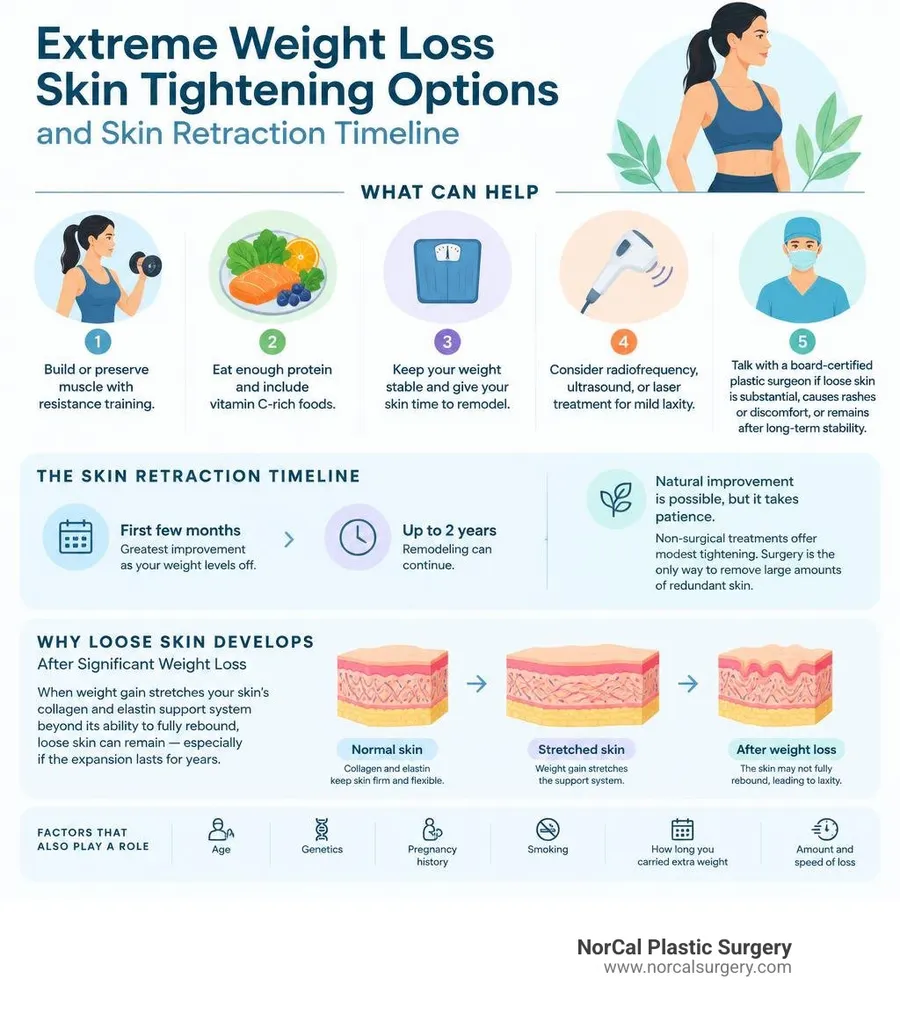
For extreme weight loss skin tightening, focus first on what can improve appearance and what cannot remove excess skin:
- Build or preserve muscle with regular resistance training.
- Eat enough protein and include vitamin C-rich foods.
- Keep your weight stable and give your skin time to remodel.
- Consider radiofrequency, ultrasound, or laser treatment for mild laxity.
- Talk with a board-certified plastic surgeon if loose skin is substantial, causes rashes or discomfort, or remains after long-term weight stability.
Loose skin happens when weight gain stretches the skin's collagen and elastin support system beyond its ability to fully rebound. Age, genetics, pregnancy history, smoking, how long you carried extra weight, and the amount and speed of loss all affect the result. GLP-1 medications such as Ozempic can make laxity appear sooner when weight comes off quickly, especially if muscle is lost along the way.
Natural improvement is possible, but it takes patience. Skin often shows its greatest improvement during the first months after your weight levels off, and remodeling can continue for up to two years. Non-surgical treatments can provide modest tightening, but surgery is the only option that can physically remove large amounts of redundant skin.
I am Dr. Timothy Rankin, a board-certified plastic surgeon and Fellow of the American College of Surgeons with training in body contouring and aesthetic surgery. My experience with extreme weight loss skin tightening helps guide a realistic, personal approach to skin health, non-surgical options, and surgical planning.
Why Loose Skin Develops After Significant Weight Loss
When you lose a large amount of weight, celebrating your health milestone is natural. Yet many patients find that excess tissue lingers. Understanding why skin behaves this way begins with dermal structure.
Your skin is an adaptable organ made of multiple layers: the outer epidermis, the structural dermis, and the deeper hypodermis. Inside the dermis lies a supportive framework of structural fibers that give skin its strength and flexibility. When tissue expands to accommodate weight gain, these fibers stretch. If that expansion lasts for years, the structural framework undergoes physical wear and tear. Once weight drops, the stretched tissue cannot always spring back into place.
Collagen, Elastin, and the Limits of Dermal Remodeling
Fibroblast cells inside the dermis actively maintain tissue by creating new structural proteins and breaking down old ones. However, while collagen turnover happens continuously at a gradual pace, mature elastin fibers do not easily regenerate during adulthood.
When skin remains overstretched for extended periods, elastin fibers fracture. Without intact elastin, the skin loses its natural snapback capacity. A comprehensive scientific evaluation of post-weight loss loose skin confirms that natural tissue remodeling has distinct biological limits, particularly when large volumes of subcutaneous fat disappear.
How GLP-1 Medications and Rapid Loss Impact Skin Elasticity
Modern weight-loss medications like semaglutide and tirzepatide have transformed metabolic health by allowing significant weight reduction. However, because weight often drops rapidly on these therapies, the skin is given very little time to adapt gradually.
When someone loses weight rapidly, a notable portion of that loss can come from lean muscle tissue rather than pure fat if nutritional support and exercise are neglected. Losing muscle removes the underlying volume that supports your skin envelope. This rapid reduction causes skin laxity to look more pronounced across the abdomen, upper arms, neck, and thighs.
Distinguishing Loose Skin from Lymphedema and Lipedema
Not all tissue fullness or fold formation after weight reduction is simple skin laxity. It is vital to differentiate loose skin from underlying lymphatic or adipose conditions.
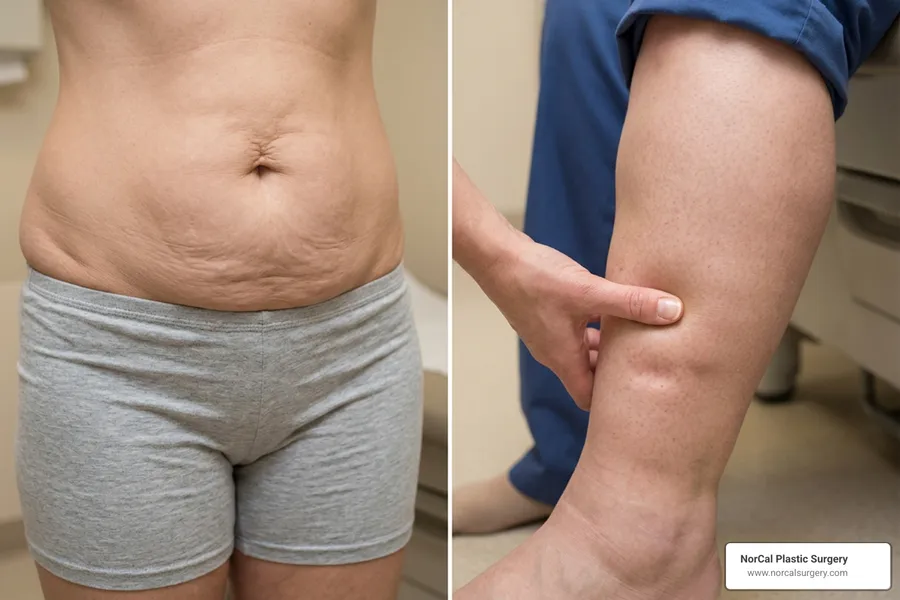
- Loose Skin: Feels thin, pliable, soft, and shifts easily with body movement without tenderness or indentation under gentle pressure.
- Lymphedema: Involves localized fluid retention caused by damaged lymphatic drainage. It creates firm, heavy swelling that often leaves a temporary indentation when pressed.
- Lipedema: A chronic fat-distribution disorder that predominantly affects the legs and arms. Lipedema tissue is often sensitive to touch, bruises easily, and does not resolve through calorie restriction or standard weight reduction.
If you experience pain, unexplained swelling, or heaviness in your extremities, a comprehensive clinical evaluation helps determine whether medical management of fluid dynamics is required before addressing cosmetic laxity.
Evidence-Based Natural and Lifestyle Strategies
Natural strategies cannot remove large aprons of redundant skin, but healthy lifestyle choices provide foundational support for tissue health, muscle structure, and general well-being.
Resistance Training and Lean Muscle Preservation
Targeted strength training is the single most valuable lifestyle strategy for improving physical contour during and after weight loss. When you lift weights or perform bodyweight exercises, you stimulate muscle growth.
While building muscle does not directly shrink the dermis, it expands the underlying lean mass. This fills out empty space beneath the skin, creating a firmer, smoother contour along the arms, back, glutes, and thighs. Aim for progressive strength sessions two to four times weekly, focusing on compound movements like squats, presses, and rows.
Nutritional Protocols: Protein Synthesis and Collagen Peptides
Your body requires specific nutritional building blocks to maintain healthy tissue.
- Dietary Protein: Strive for adequate protein intake throughout the day from lean meats, fish, eggs, tofu, or legumes to preserve lean tissue and support ongoing cellular repair.
- Vitamin C: A vital micronutrient required by fibroblasts to produce structural protein cross-links. Citrus fruits, bell peppers, and leafy greens supply natural vitamin C.
- Collagen Peptides: Oral collagen supplements offer small amounts of amino acids like glycine and proline. While clinical data shows modest improvements in skin hydration, oral powders cannot erase major skin redundancy.
- Hydration: Proper fluid intake supports cellular plumpness and overall tissue health, though drinking water alone cannot re-tighten severely stretched skin.
Natural Interventions vs Extreme Weight Loss Skin Tightening Procedures
There is a clear threshold where lifestyle habits stop producing visible changes. Natural methods work well for mild laxity in younger individuals with good tissue tone. However, for significant tissue redundancy, natural measures reach a biological ceiling.

Reviewing practical research on skin tightening protocols shows that lifestyle improvements are most effective when paired with realistic expectations regarding what requires clinical correction.
Non-Surgical and Energy-Based Modalities
For individuals with mild to moderate laxity who do not have hanging skin folds, non-invasive technologies provide a helpful bridge.
High-Intensity Focused Ultrasound and Radiofrequency Therapy
Energy-based devices work by delivering controlled heat to the deeper dermal layers without breaking the surface of the skin.
- Radiofrequency (RF): Uses electrical current to heat the dermis to a target temperature, encouraging fibroblast activity and tissue contraction over several months.
- High-Intensity Focused Ultrasound (HIFU): Uses focused sound waves to create precise points of thermal energy deep within tissue layers, stimulating natural firming responses.
These treatments are performed in an office setting with little to no downtime. Patients often undergo a series of sessions spaced several weeks apart, with gradual improvements developing over three to six months.
Realistic Expectations and Limitations of In-Office Treatments
Non-surgical energy treatments tighten tissue on a subtle, cellular level. They do not cut away or lift large amounts of loose skin.
| Factor | Energy-Based Treatments (RF / HIFU) | Surgical Body Contouring |
|---|---|---|
| Primary Indication | Mild to moderate skin laxity | Substantial, hanging skin folds |
| Skin Removal | None | Direct physical excision |
| Onset of Results | Gradual over 3 to 6 months | Immediate structural change |
| Treatment Course | Multiple sessions plus maintenance | Single operation per region |
| Downtime | Minimal to none | Several weeks of guided healing |
Clinical and Surgical Pathways for Extreme Weight Loss Skin Tightening
When weight reduction is substantial, the volume of leftover skin often creates functional and hygiene challenges. In these circumstances, surgical contouring is the most direct and predictable solution.
Is Surgery the Only True Solution for Extreme Weight Loss Skin Tightening?
For significant tissue aprons, surgery is the only method capable of excising excess dermal redundancy and restoring anatomical contours.
When skin hangs in heavy folds, it causes persistent chafing, skin breakdowns, moisture accumulation, and physical restriction during exercise. In my practice at NorCal Plastic Surgery, I meet with patients from across the SF Bay Area, including our offices in Walnut Creek and our surgical facility in Tiburon in Marin County, to evaluate whether surgery is the right next step.
Body Contouring Procedures: Abdominoplasty, Panniculectomy, and Lifts
Body contouring is tailored to the specific anatomical areas where excess tissue collects:
- Panniculectomy: Focuses strictly on removing the hanging apron of skin and fat (the pannus) from the lower abdomen to resolve hygiene and functional issues.
- Extended Abdominoplasty: Removes excess abdominal skin, tightens separated abdominal wall muscles, and contours the waistline and hips.
- Brachioplasty (Arm Lift): Removes loose skin from the underarm area down to the elbow.
- Thighplasty (Thigh Lift): Tightens and reshapes the inner and outer thighs for improved comfort while walking.
- Lower Body Lift: A comprehensive procedure that addresses the abdomen, outer thighs, and buttocks in a continuous circumferential approach.
Insurance Coverage Criteria, Candidacy, and Stability Timelines
To achieve safe, enduring surgical results, timing is essential. Patients should maintain a stable weight for at least six to twelve months before undergoing elective body contouring.
While purely cosmetic procedures are self-pay, certain functional procedures like a panniculectomy may qualify for partial insurance coverage if you have well-documented medical necessity. Insurers typically look for recurrent intertrigo (skin fold rashes), chronic infections that fail to resolve with prescription topicals, or documented mobility impairment.
Frequently Asked Questions About Post-Weight Loss Skin Tightening
How long does natural skin retraction take after weight stabilization?
Natural dermal remodeling takes between twelve and twenty-four months after your weight becomes stable. The most noticeable natural tightening occurs in the first six months. If significant skin laxity remains after two full years of stable weight, it will not resolve without surgical excision.
Can you fully prevent sagging skin during rapid weight reduction?
You cannot completely prevent loose skin if you lose a massive amount of weight, because genetic factors, age, and previous tissue stretching play major roles. However, you can minimize laxity by losing weight at a steady pace, prioritizing dietary protein, and consistently lifting weights to protect your lean muscle volume.
What is the typical financial investment for skin removal surgery?
The investment for body contouring varies depending on the specific procedures needed, surgical facility fees, anesthesia care, and geographic location. Because NorCal Plastic Surgery provides customized surgical plans tailored to each individual, details regarding procedural planning are discussed directly during your private consultation.
Conclusion
Losing weight through lifestyle changes, bariatric surgery, or GLP-1 medications is a life-changing accomplishment. Managing the resulting loose skin requires an honest, multi-step approach: start with strength training and proper nutrition, give your body time to settle, and consider procedural care when natural efforts reach their limit.
If you are curious about the biological mechanisms of loose skin and surgical solutions, exploring your options with an experienced surgeon is the best way forward. At NorCal Plastic Surgery, we work closely with patients across the Bay Area to design personalized, safe plans that restore natural comfort, mobility, and confidence.