
Facial rejuvenation refers to a range of treatments designed to restore a more youthful, rested appearance to the face, from non-surgical injectables and energy devices to surgical facelifts.
Quick overview of the most common options:
| Treatment | Type | Best For | Longevity |
|---|---|---|---|
| Botulinum toxin (Botox, Dysport) | Non-surgical | Dynamic wrinkles, skin quality | 3–6 months |
| Hyaluronic acid fillers | Non-surgical | Volume loss, contouring | 9–18 months |
| Collagen stimulators (PLLA, CaHA) | Non-surgical | Skin laxity, deep remodeling | 1–2+ years |
| Energy-based devices (RF, laser, ultrasound) | Non-surgical | Skin tightening, texture | Varies |
| Facelift (rhytidectomy) | Surgical | Significant sagging, jowls | 7–10 years |
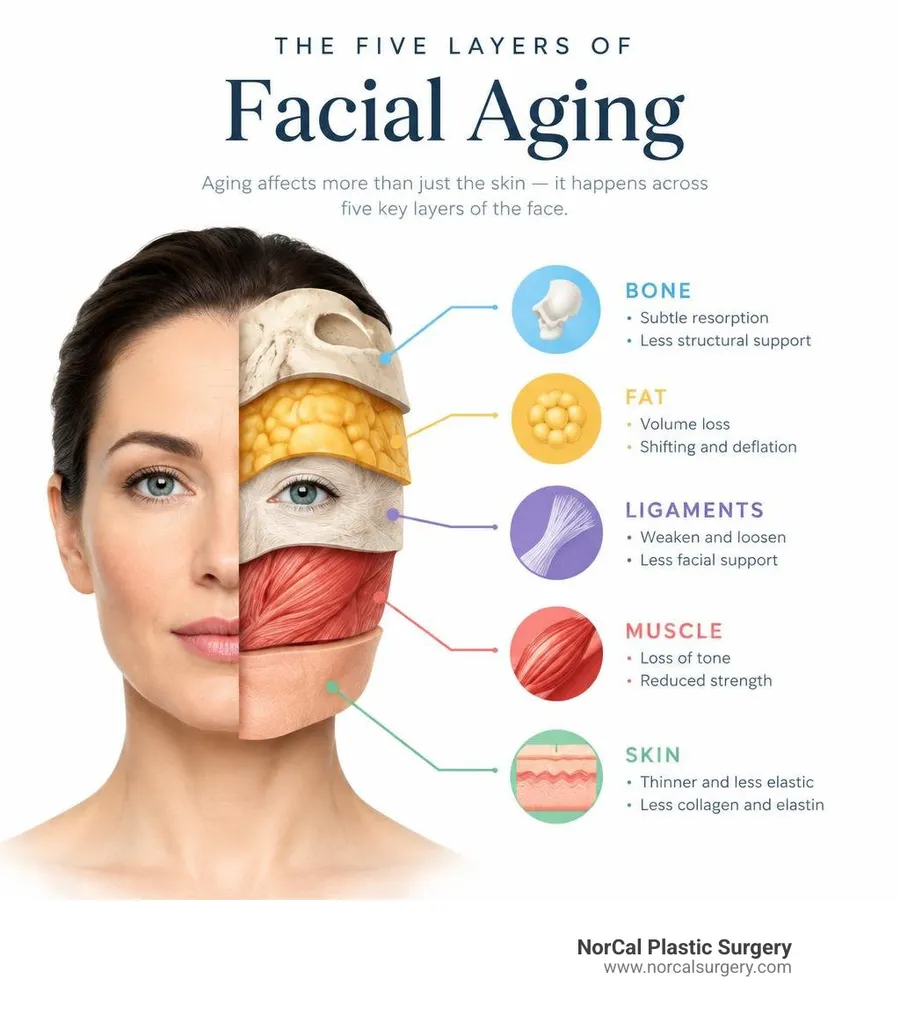
Aging does not happen in just one layer. It unfolds across every layer of the face: bone, fat, muscle, ligaments, and skin.
That is why a single treatment rarely tells the whole story.
As adults age, collagen, elastin, and hyaluronic acid production gradually decline. Fat pads can shift and deflate, bones can subtly resorb, and skin can become thinner and less elastic. The result is the gradual change many people notice in the mirror, including sagging, hollowing, lines, and lost definition.
The good news is that modern aesthetic medicine has advanced dramatically. Today, treatments can target specific layers of facial aging, not just the surface. Interest in noninvasive aesthetic care is also expected to continue growing through 2030, reflecting the demand for personalized options.
Whether you are noticing early signs of aging in your 30s or considering more comprehensive restoration in your 40s and 50s, understanding your options is the first step toward results that look natural, not overdone.
I'm Dr. Timothy Rankin, a board-certified plastic surgeon and Fellow of the American College of Surgeons who specializes in facial rejuvenation surgery, rhinoplasty, and comprehensive aesthetic care for the SF Bay Area. I've trained alongside some of the most respected names in facial aesthetic surgery and believe deeply that every patient deserves a personalized plan, not a one-size-fits-all approach. Let's walk through everything you need to know.
The Multi-Layered Anatomy of Facial Aging
To understand how to reverse facial aging, we must first look at the face as a dynamic, three-dimensional structure. It is built like a house: if the foundation shifts, the walls crack, and the exterior siding begins to warp. In the human face, this structure consists of five distinct anatomical layers.
1. Skeletal Resorption (The Foundation)
As we age, our bones do not remain static. In the face, we experience age-related bone resorption, particularly around the eye sockets (orbits), the upper jaw (maxilla), and the jawline (mandible). The piriform aperture, the bony opening for the nose, can widen, causing the nasal base to lose support. This skeletal retreat reduces the structural scaffolding of the face, leaving the overlying soft tissues with less support and contributing to inward and downward changes.
2. Fat Compartment Shifts
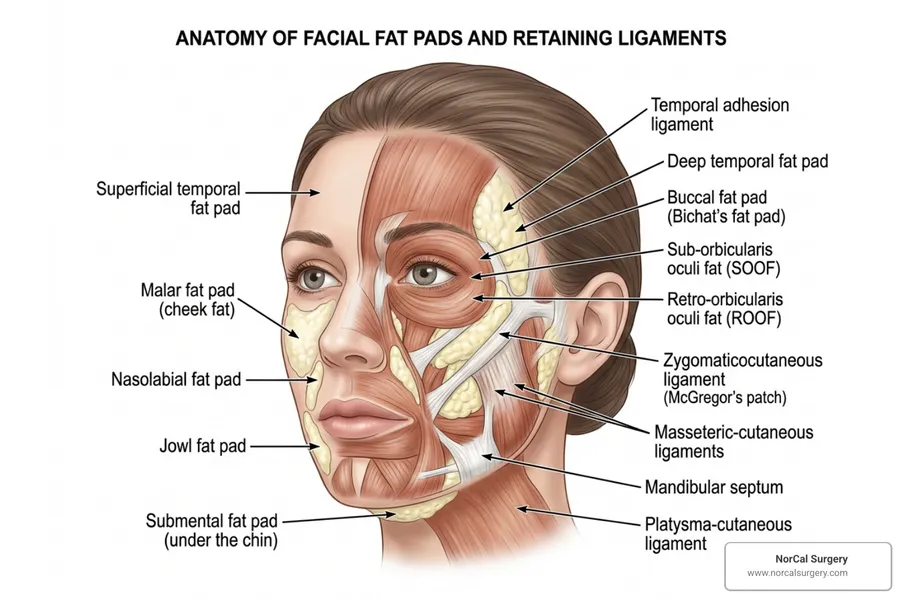
Facial fat is partitioned into highly distinct deep and superficial fat compartments.
- Deep fat pads (such as the deep pyriform and medial cheek fat) act as structural cushions in the midface. With age, these compartments can deflate or atrophy.
- Superficial fat pads (like the malar fat pad) can descend as support weakens.
This combination of deep deflation and superficial descent can contribute to hollows under the eyes, flattening of the cheeks, and tissue accumulation along the jawline, commonly known as jowls.
3. Ligamentous Laxity
The face is held together by a network of tough, fibrous bands called retaining ligaments. These ligaments run from the bone or deep fascia through to the skin, anchoring the soft tissues in place. Over time, these ligaments can stretch and weaken. When the zygomaticocutaneous ligament, which supports the cheek, and the mandibular retaining ligament weaken, they can allow superficial fat pads and skin to descend.
Understanding this ligamentous network is important for both surgical and non-surgical treatments. For example, a surgeon performing a deep-plane facelift may release selected ligaments to mobilize and reposition deeper tissues. You can read more about these deep structural relationships in this comprehensive guide on Cervicofacial Rhytidectomy anatomy.
4. Muscular Imbalance
Our facial muscles are constantly in motion and include "elevators," which pull tissues upward, and "depressors," which pull tissues downward. As we age, muscular imbalance can develop. Depressor muscles, such as the platysma in the neck and the depressor anguli oris at the corners of the mouth, may become more active. This downward pull can contribute to lower-face laxity, downturned mouth corners, and a softer jawline.
5. Dermal and Epidermal Thinning
At the surface, the skin itself undergoes meaningful physiological changes. Collagen production declines progressively with age, while elastin fibers degrade and skin loses some of its snapback elasticity. Natural hyaluronic acid production can also decrease. This structural breakdown in the extracellular matrix can appear as fine lines, static wrinkles, crepey texture, and a dull or dehydrated skin tone.
Non-Surgical Options for Facial Rejuvenation
Because facial aging involves changes in volume, muscle movement, skin quality, and tissue support, the right approach is often a personalized combination of treatments rather than a single procedure.
Dermal Fillers for Subtle Volume and Contour
Hyaluronic acid dermal fillers can restore volume in areas that have become hollow or flattened over time. Depending on your anatomy and goals, they may be used to support the cheeks, soften deeper facial folds, improve chin or jawline definition, or refresh other areas of the face.
A thoughtful treatment plan focuses on balance rather than adding volume everywhere. The goal is to support the facial features that have changed with age while preserving your natural expression.
Collagen Stimulators for Gradual Improvement
Collagen stimulators are injectable treatments designed to encourage your body to build more of its own supportive collagen over time. They can be useful for patients who want gradual improvement in facial volume, skin firmness, or texture rather than an immediate change.
Depending on the product and treatment area, results develop over several months and may last longer than some traditional fillers. Your provider can help determine whether this approach fits your goals, timeline, and medical history.
Botulinum Toxin for Expression Lines
Botulinum toxin treatments, including Botox, Dysport, Xeomin, and Daxxify, relax selected muscles that contribute to expression lines such as frown lines, forehead lines, and crow's feet. In the right areas, they may also help soften a downturned mouth appearance or reduce strong neck-band activity.
The best results maintain natural movement. Treatment should be tailored to your facial anatomy and how much motion you want to preserve.
Skin Tightening and Resurfacing Treatments
Energy-based treatments use heat, light, or controlled injury to support collagen remodeling and improve skin quality. Depending on the technology, they may help address mild skin laxity, fine lines, uneven texture, sun damage, and pigment concerns.
Options can include ultrasound treatments, radiofrequency microneedling, and laser resurfacing. Some treatments involve little downtime, while others require more recovery in exchange for a more intensive resurfacing effect. A consultation can help match the treatment to your skin type, goals, and tolerance for downtime.
Creating a Personalized Facial Rejuvenation Plan
Achieving a natural, balanced result usually requires a customized plan. Treating only one concern, such as filling a fold without considering the cheeks or skin around it, can make the face look less balanced.
| Treatment | What It Can Address | Main Benefit |
|---|---|---|
| Dermal fillers | Volume loss and facial contours | Adds support and softens selected hollows or folds |
| Collagen stimulators | Gradual volume loss and skin firmness | Supports gradual, natural-looking improvement |
| Botulinum toxin | Expression lines and selected muscle activity | Softens wrinkles while preserving appropriate movement |
| Skin-tightening and resurfacing treatments | Texture, fine lines, and mild laxity | Improves skin quality and can provide subtle tightening |
How Treatments May Be Combined
The order of treatment depends on your goals, anatomy, and the type of change you are trying to achieve. In many cases, it makes sense to address foundational concerns first, then refine expression lines and skin quality.
- Support and contour: Fillers or collagen stimulators may be used to restore facial support or volume where it has been lost.
- Expression lines: Botulinum toxin can soften lines caused by repeated muscle movement.
- Skin quality: Lasers, radiofrequency microneedling, ultrasound treatments, or other resurfacing options may help improve texture, tone, and mild laxity.
Not everyone needs every option. The right combination should be based on a careful consultation, realistic goals, your medical history, and the amount of downtime you are comfortable with.
Your Features and Goals Should Lead the Plan
Every face is different. A thoughtful plan considers your facial structure, skin type, areas of concern, and the look you want to maintain.
Skin tone and sensitivity can influence which devices or resurfacing treatments are most appropriate, particularly when there is a risk of pigment changes after treatment. Personal preferences matter, too. Some patients want more defined contours, while others prefer a softer, refreshed appearance. The goal is to enhance your features in a way that still looks like you.
Safety, Risk Mitigation, and Emerging Regenerative Therapies
While non-surgical treatments can be highly effective, they are still medical procedures that require a thorough understanding of facial anatomy and careful patient selection.
Complication Management and Safety Protocols
The most serious risk associated with dermal fillers is vascular occlusion (VO). This occurs when filler enters or compresses a blood vessel and disrupts blood flow to surrounding tissue. If not recognized and treated promptly, VO can lead to skin injury and, in extremely rare cases, vision loss.
To help reduce risk, treatment should be performed by a qualified medical professional who uses an anatomy-informed approach and maintains appropriate emergency protocols. Safety planning may include conservative product selection, careful injection technique, use of cannulas in suitable areas, and immediate access to hyaluronidase for hyaluronic acid filler complications.
Patients should also be prepared for common, temporary effects such as mild discomfort, redness, swelling, and bruising.
The Evidence Base for Regenerative Esthetics
Regenerative medicine is an exciting frontier in aesthetic treatments. However, it is important to separate scientific evidence from marketing hype:
- Platelet-Rich Plasma (PRP) and Platelet-Rich Fibrin (PRF): These treatments use a concentrated sample of a patient's own blood to isolate platelet-rich material. They may be injected or used alongside procedures such as microneedling to support healing and improve the appearance of skin quality.
- Exosomes and Growth Factors: Exosomes are tiny vesicles released by cells that carry proteins, lipids, and RNA to help cells communicate. Early research suggests potential applications in skin regeneration and wound healing, but products and protocols are not yet standardized. More long-term, large-scale clinical research is needed to clarify safety, consistency, and appropriate use.
Frequently Asked Questions about Facial Rejuvenation
What is the optimal age to begin facial rejuvenation treatments?
There is no single "perfect" age to start. Instead of looking at the calendar, we look at your individual anatomy and skin quality.
In your late 20s and early 30s, treatments often focus on "prejuvenation": preventative steps like daily sun protection, medical-grade skincare, and low-dose neuromodulators that may help keep dynamic lines from becoming more established. By the mid-30s and 40s, as collagen loss and early volume shifts develop, some patients may add subtle fillers or collagen stimulators to maintain a refreshed, natural look.
How do surgical facelifts compare to non-surgical liquid facelifts?
A "liquid facelift" uses a combination of fillers and neuromodulators to temporarily restore lost volume and smooth wrinkles. It can be a low-downtime option for patients with mild-to-moderate volume loss.
However, non-surgical treatments cannot remove loose, sagging skin. If you have significant skin laxity, deep jowls, or loose skin along the neck, a surgical facelift, such as a deep-plane or SMAS lift, may provide a more transformative and long-lasting result. A liquid facelift may last 9 to 18 months, while facelift results can endure for many years.
What are the most common side effects of energy-based devices?
Most patients experience mild redness (erythema), slight swelling, and a warm, sunburn-like sensation for a few hours to a few days after treatment. With deeper resurfacing treatments, you may also experience mild peeling, flaking, or temporary bronzing of the skin. We provide detailed pre- and post-care instructions, including strict sun protection, to support safe healing.
Conclusion
Facial aging is a natural, multi-layered process, but today's advanced treatments offer more options than ever to refresh and restore your appearance. Whether you are looking for subtle, non-surgical enhancements or considering a more permanent surgical transformation, the key to natural-looking results is a highly personalized treatment plan.
At NorCal Plastic Surgery, board-certified plastic surgeon Dr. Timothy Rankin and our expert team provide safe, scientifically informed treatments tailored to your unique anatomy. From our accredited surgical facility in Tiburon to our medical spa services, we proudly serve patients across the SF Bay Area, including Walnut Creek, North Bay, East Bay, and Marin County.
Are you ready to take the next step? Schedule a consultation for facial rejuvenation with us today, and let's design a plan that helps you look and feel your absolute best.