A Brazilian Butt Lift (BBL) after weight loss is a fat transfer procedure that restores lost gluteal volume and shape using purified fat from the patient’s own body. It is often recommended because significant weight loss, whether from bariatric surgery, GLP-1 medications like Wegovy or Ozempic, or lifestyle changes, can reduce fat volume throughout the body. For many individuals, this leads to a flatter, squarer, or deflated gluteal profile along with varying degrees of skin laxity.
The buttocks naturally rely on a balance of underlying gluteal muscle, subcutaneous fat, and skin elasticity to maintain an uplifted, rounded projection. Major weight reduction can alter these soft-tissue layers in several ways:
- Adipose volume loss: The localized fat layer that creates youthful curvature diminishes, leaving the area looking hollow or sagging.
- Tissue shifting: Deflated tissues can descend, altering the natural waist-to-hip ratio.
- Skin laxity: Stretched skin may not retract fully around the smaller underlying volume.
Autologous fat grafting, commonly known as a Brazilian Butt Lift (BBL), can restore lost shape with the patient’s own living tissue. Unlike synthetic implants, which may shift, feel firm, or show visible edges in post-weight-loss patients with thinner tissue layers, a BBL uses purified fat harvested from areas such as the flanks, back, or abdomen. This approach can contour the midsection while restoring projection, improving symmetry, and rebuilding balanced curves.
At NorCal Plastic Surgery, treatment plans are customized around each patient’s anatomy, tissue quality, fat distribution, and aesthetic goals. The focus remains on smooth, natural-looking contours designed to last.
Are You an Ideal Candidate for a Brazilian Butt Lift After Weight Loss?

Undergoing a BBL after substantial weight reduction requires careful clinical evaluation. Because the body has experienced metabolic, hormonal, and structural shifts, candidate selection depends on specific health benchmarks rather than simply a number on the scale.
1. Weight Stability for at Least Six Months
Patients should maintain a stable weight for a minimum of six months before considering surgery. If weight loss is still ongoing, transferred fat cells may continue to shrink along with the rest of the body, compromising the surgical outcome. Rapid weight gain after surgery can also alter newly sculpted proportions.
2. Adequate Donor Fat Reserves
A BBL relies entirely on having enough viable fat to harvest and transfer. Following major weight loss, some patients find their overall body fat depleted. A thorough physical assessment identifies possible donor regions, including:
- The lower and upper abdomen
- The posterior flanks (love handles)
- The mid-to-lower back
- The inner and outer thighs
3. Baseline Skin Elasticity and Tissue Quality
Skin needs sufficient tone to drape smoothly over newly added fat volume. With mild to moderate laxity, fat grafting can help fill the soft-tissue envelope. However, severe redundant skin folds may not be corrected by fat transfer alone, and specialized excisional body contouring may be discussed.
4. Metabolic and Nutritional Normalization
Patients who lose weight through bariatric surgery or medical therapies may experience temporary micronutrient deficiencies or fluctuating protein levels. Newly grafted fat cells require a healthy capillary network and adequate nutritional support to survive, so metabolic panels should demonstrate nutritional balance. Careful surgical timing and recovery preparation help ensure the body is ready for healthy healing. Comprehensive blood work, including complete blood counts, electrolyte panels, and total protein evaluations, helps confirm surgical readiness.
Patients seeking to harmonize their overall proportions can explore tailored surgical body contouring procedures designed to address multiple areas of the body in a structured, safe progression.
How Does a BBL Restore Body Contours After Bariatric Surgery or GLP-1 Medications?
The rapid fat reduction associated with GLP-1 receptor agonists and bariatric procedures can leave pockets of stubborn fat in the waistline while reducing volume in the buttocks and hips. A post-weight-loss BBL selectively removes suitable fat deposits and uses them to rebuild a smoother, more contoured silhouette.
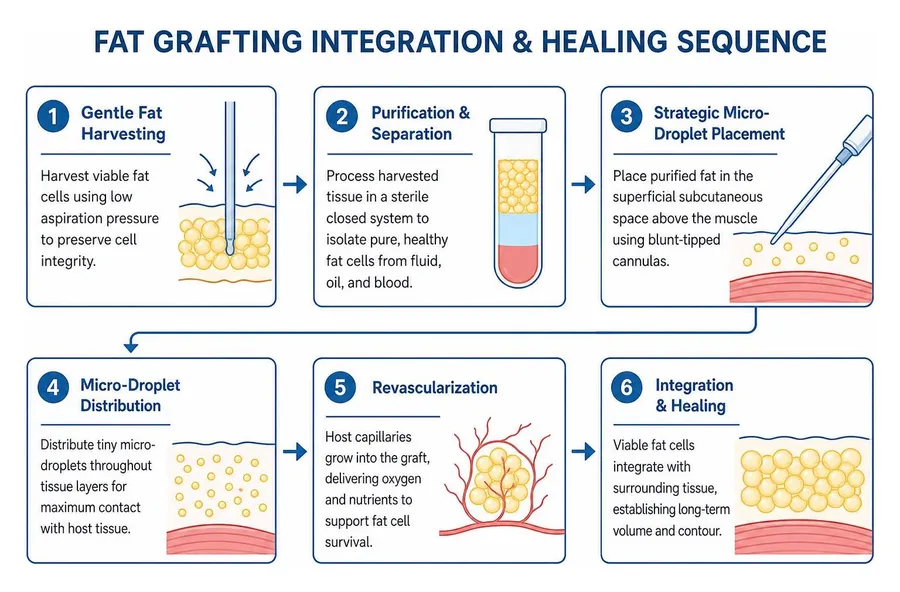
The surgical restoration follows a meticulous, multi-phase process:
- Gentle Fat Harvesting: Specialized liposuction techniques harvest viable fat cells at low aspiration pressures. This gentle approach helps preserve cell integrity, which supports graft survival.
- Purification and Separation: The harvested tissue is processed using a sterile closed system that separates healthy fat cells from tumescent fluid, oil droplets, and blood components.
- Strategic Micro-Droplet Placement: Using specialized blunt-tipped cannulas, the surgeon places purified fat in the superficial subcutaneous space directly beneath the skin and above the gluteal muscle. Distributing tiny micro-droplets throughout the tissue layers helps each graft remain close to host tissues that provide oxygen and nutrients.
Placing fat above the muscle is the standard safety protocol at NorCal Plastic Surgery. Fat is not injected into deep muscular layers.
Following transplantation, living fat cells undergo a critical phase in which new micro-capillaries grow into the grafted tissue and establish a permanent blood supply. Once integrated, surviving fat cells become a lasting part of the patient’s anatomy and respond to normal physiologic changes like other fat cells in the body.
What Should You Expect During BBL Surgery and Recovery?
A BBL is typically performed under general anesthesia in an accredited surgical setting and lasts between three and four hours, depending on the number of donor sites treated. Because protecting newly grafted fat cells is essential to achieving an optimal outcome, following a dedicated post-operative recovery protocol is vital.
The Golden Rule: Eliminating Direct Pressure
Grafted fat cells are delicate during the initial healing window while new blood vessels develop. Sitting or lying directly on the buttocks compresses the tissue, which can restrict blood flow and compromise fat-cell survival.
- Patients should avoid sitting directly on the buttocks for at least two to three weeks following surgery.
- When resting, patients should sleep on the stomach or sides.
- If sitting is unavoidable, use an ergonomic post-operative cushion beneath the upper thighs to keep the gluteal area elevated and free from direct contact.
Medical-Grade Compression Garments
Patients wear a specialized compression garment, often called a faja, around the donor sites continuously for the first several weeks. This garment can:
- Minimize post-surgical swelling and fluid accumulation
- Support skin retraction across the abdomen, flanks, and thighs
- Encourage smooth, uniform healing across treated areas
Post-Operative Recovery Timeline
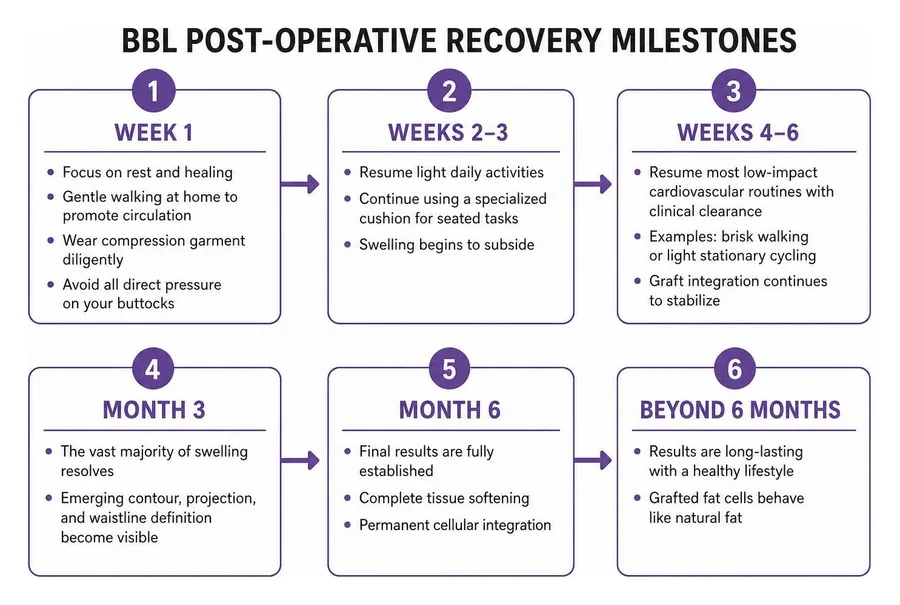
- Week 1: Focus on rest, gentle walking around the house to promote healthy circulation, diligent use of the compression garment, and avoiding direct pressure on the buttocks.
- Weeks 2 to 3: Light daily activities may resume; patients continue using a specialized cushion for seated tasks while swelling begins to subside.
- Weeks 4 to 6: Most low-impact cardiovascular routines, such as brisk walking or light stationary cycling, may resume with clinical clearance while graft integration continues to stabilize.
- Month 3: Most post-operative swelling has resolved, revealing the emerging contour, projection, and waistline definition.
- Month 6: Final results are generally established, with continued tissue softening and fat-graft integration.
Nutrition and Lifestyle During Healing
Nutrition supports tissue repair during recovery. Patients are generally advised to eat a protein-rich diet with lean meats, fish, eggs, legumes, and healthy fats, while drinking between 1.5 and 2 liters of water daily. Caloric restriction or dieting is generally discouraged during the initial recovery months because transplanted fat cells need adequate nutritional support as they integrate.
NorCal Plastic Surgery also provides wellness treatments and care plans to support recovery and long-term vitality.
Can You Combine a BBL With Other Post-Weight-Loss Body Contouring Procedures?
Significant weight reduction rarely affects only one area of the body. Many patients find that while the buttocks have lost volume, the abdomen, breasts, and back also show loose skin or residual fat pockets that may not respond to diet alone.
Combining a BBL with complementary body contouring surgeries can create balanced, full-body proportions within a cohesive surgical plan. Common combinations include:
- Tummy Tuck (Abdominoplasty): Fat harvesting from the abdomen and flanks may be combined with abdominal muscle repair and skin tightening to create a more defined transition between the abdomen and gluteal contour.
- Lower Body Lift: For patients with circumferential skin laxity around the lower torso, a lower body lift removes excess tissue from the abdomen, hips, and outer thighs while local tissue rearrangement or fat grafting may restore buttock fullness.
- Breast Rejuvenation: A breast lift, with or without augmentation, can balance the upper and lower torso for a more proportional silhouette.
For comprehensive, full-body rejuvenation, NorCal Plastic Surgery offers customized pathways such as NorCal 360 transformation protocols, which address multiple aesthetic goals through safe, coordinated surgical stages.
During a comprehensive consultation at NorCal Plastic Surgery, the surgical team evaluates anatomy, overall health, and personal goals to determine whether a combined single-stage procedure or a staged approach is the safest and most effective option.
What Are the Most Frequently Asked Questions About BBL After Weight Loss?
How long should you wait after weight loss before getting a BBL?
You should wait until your weight has remained completely stable for at least six consecutive months. This waiting period allows your metabolism to normalize, ensures your skin has retracted as much as possible on its own, and confirms that your nutritional reserves are adequate for optimal wound healing and graft survival.
What happens to transferred fat if you lose more weight after surgery?
Once transferred fat cells establish a blood supply, they behave identically to the fat cells in the rest of your body. If you lose substantial weight after your procedure, those cells will shrink, which can reduce buttock projection and alter your contour. To preserve your results, you should maintain your post-operative weight within a stable range of five to ten pounds.
Can a Brazilian Butt Lift fix severe sagging skin after massive weight loss?
A BBL primarily restores lost volume and improves contour, but it is not a substitute for skin removal surgery. While adding volume can smooth out mild skin laxity, moderate to severe hanging skin folds require an excisional procedure, such as a lower body lift or buttock lift, to remove excess tissue before or alongside fat grafting.
How Do You Maintain Your Brazilian Butt Lift Results for Life?
A Brazilian Butt Lift can provide long-lasting contouring, but preserving the newly sculpted silhouette requires consistent, healthy habits. Because transferred fat cells respond to changes in energy balance, maintaining a steady weight is one of the most effective ways to protect surgical results.
Key strategies for long-term maintenance include:
- Balanced, Nutrient-Dense Nutrition: Focus on whole foods, lean proteins, and complex carbohydrates to support metabolic health while avoiding significant weight fluctuations.
- Targeted Resistance Training: Once cleared for strenuous exercise, glute-focused strength movements such as hip thrusts, squats, lunges, and deadlifts can build the underlying gluteal muscle base and support overall projection and firmness.
- Routine Follow-Up Care: Staying connected with the surgical team helps support smooth healing and long-term body contouring goals.
Patients who are ready to explore how autologous fat grafting may restore curves and complete a body transformation can schedule a consultation at NorCal Plastic Surgery’s SF Bay Area locations in Tiburon or Walnut Creek. Explore the full range of advanced surgical procedures to learn how a personalized contouring plan can support natural, enduring confidence.