Why Bay Area Breast Augmentation Is Worth Getting Right
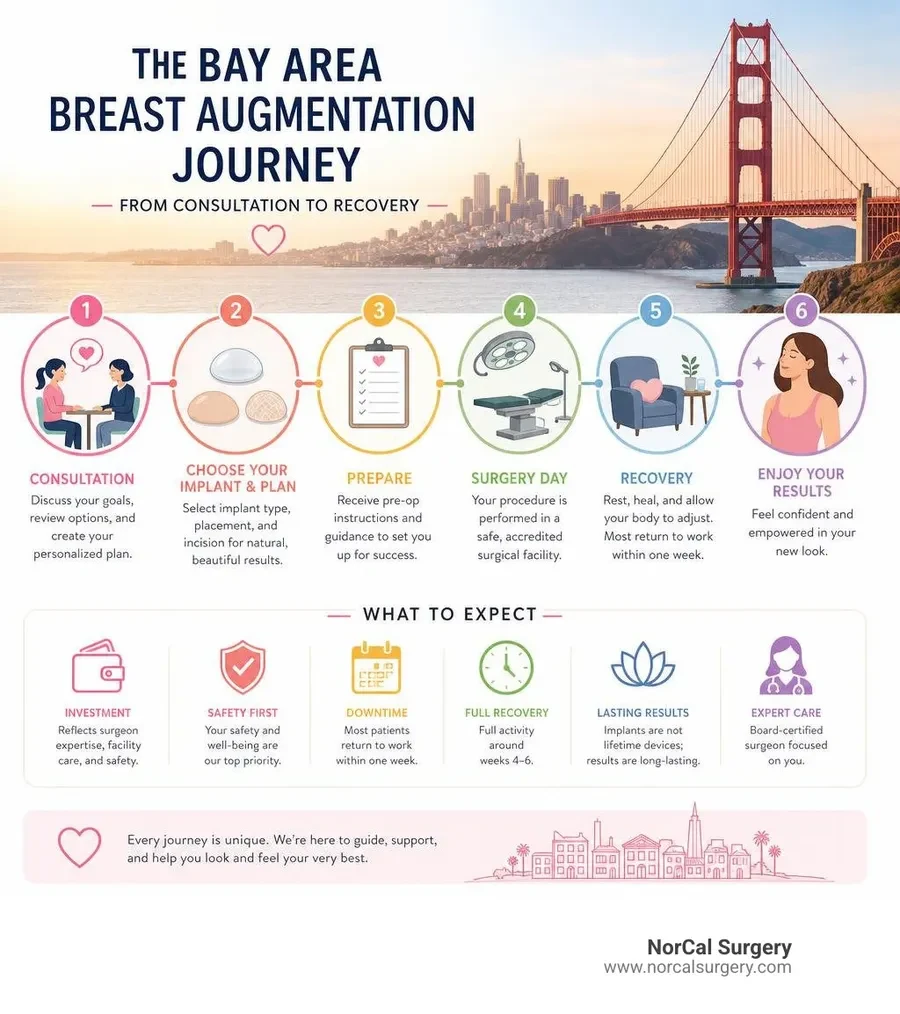
If you're exploring SF Bay Area breast augmentation, here's a quick overview of what to expect:
Top things to know at a glance:
- Implant types: Silicone gel, saline, and structured implants each have different feel, safety considerations, and FDA age requirements.
- Placement options: Submuscular, subglandular, subfascial, or dual-plane placement is chosen based on your anatomy and goals.
- Recovery: Many patients return to desk-based work within about a week, while full activity commonly resumes around weeks 4–6 with surgeon clearance.
- Long-term planning: Implants are not lifetime devices, so future monitoring or revision may be appropriate depending on your needs.
- Surgeon selection: Look for a board-certified plastic surgeon with substantial breast-surgery experience and an accredited surgical facility.
Breast augmentation is a popular cosmetic surgery procedure in the United States. For busy moms and women in their 30s and 40s throughout Marin County, Tiburon, the North Bay, Walnut Creek, and the East Bay, it can address changes such as volume loss after pregnancy, asymmetry, or breasts that no longer reflect how they feel inside.
The procedure is not one-size-fits-all. Implant type, placement, incision location, and surgeon experience all shape your results and recovery. Getting those decisions right matters.
Dr. Timothy Rankin is a board-certified plastic surgeon and Fellow of the American College of Surgeons who trained in breast surgery under nationally recognized specialists, including the inventor of the modern breast implant. That experience informs every Bay Area breast augmentation consultation at NorCal Surgery. The sections below explain the decisions that can help patients make a confident, informed choice.
*Individual Results May Vary
Understanding Your Implant Options: Silicone, Saline, and Structured
Choosing the right implant is one of the most exciting parts of planning your SF Bay Area breast augmentation. Today, three primary categories of implants offer distinct benefits in look, feel, and long-term safety. Patient education is an important first step toward a beautiful, enduring result. The FDA also provides patient-facing information on breast implant risks, benefits, and monitoring for anyone considering augmentation.
Silicone Gel Implants
Silicone gel implants are a popular choice for Bay Area patients, including those from Marin County, Tiburon, Walnut Creek, the North Bay, and the East Bay. Modern silicone implants are filled with a highly cohesive gel, often referred to as "gummy bear" implants because they retain their shape even if the outer shell is cut or damaged.
- Look and Feel: Silicone gel closely mimics the natural weight, movement, and softness of natural breast tissue.
- Safety & Age Requirements: The FDA has approved silicone gel implants for cosmetic breast augmentation in women aged 22 and older.
- Rippling: Because they are pre-filled with a cohesive gel, they are significantly less likely to ripple or wrinkle under the skin compared to traditional saline options.
Saline Implants
Saline implants consist of an empty silicone elastomer shell that is inserted into the breast pocket and then filled with sterile saltwater (saline) during surgery.
- Look and Feel: Saline implants tend to feel firmer than silicone and may have a slightly more rounded, bounce-like projection.
- Safety & Age Requirements: FDA-approved for cosmetic use in patients aged 18 and older. If a saline implant ruptures, it deflates rapidly as the harmless saltwater is naturally absorbed by the body.
- Key Advantage: They require a slightly smaller incision because the shell is rolled up and inserted empty before being filled.
Structured Saline (The Ideal Implant)
For patients who want the safety profile of saline but the natural feel of silicone, the Ideal Implant is an excellent alternative. It features a patented, multi-shell structured design with two separate saline chambers.
- Look and Feel: This internal structure controls the movement of the saltwater, dramatically reducing the "sloshing" and edge rippling common in standard saline implants.
- Monitoring: Unlike silicone gel implants, which require periodic imaging (like ultrasound or MRI) to detect "silent ruptures," a rupture in an Ideal Implant is immediately visible because the breast will lose volume, allowing for stress-free monitoring.
| Implant Type | FDA Age Requirement | Primary Benefit | Potential Drawback | Feel |
|---|---|---|---|---|
| Silicone Gel | 22+ | Most natural look and feel; minimal rippling | Requires imaging for silent rupture detection | Very soft, mimics natural tissue |
| Traditional Saline | 18+ | Harmless absorption if ruptured; smaller incisions | Higher risk of visible rippling; firmer feel | Firm, round projection |
| Ideal Implant (Structured) | 18+ | Saline safety with silicone-like feel; no silent ruptures | Slightly more expensive than standard saline | Soft, natural movement |
To learn more about how these choices are personalized for individual anatomy, explore the comprehensive guide on Breast Augmentation at NorCal Surgery.
Implant Placement and Incision Techniques
How your implant is placed and where the incision is made will directly impact your recovery comfort, the natural movement of your breasts, and the visibility of any scarring. During a consultation at the Bay Area offices, the surgical team evaluates tissue elasticity, rib cage structure, and lifestyle to determine the optimal approach for patients from Tiburon, Marin County, Walnut Creek, the North Bay, and the East Bay.
Implant Placement Options
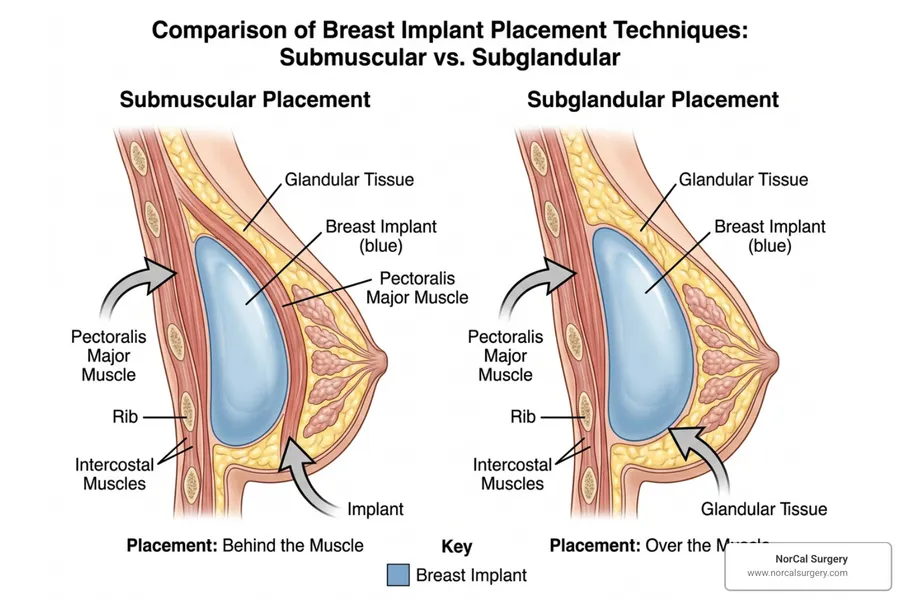
There are three main anatomical "pockets" where your implant can be positioned:
- Submuscular (Under the Muscle): The implant is placed completely or partially beneath the pectoralis major muscle. This is the most common recommendation for patients with minimal natural breast tissue. It provides excellent upper-pole coverage, creates a soft slope, and lowers the risk of capsular contracture (the hardening of scar tissue around the implant) to under 10%. It also makes future mammograms much easier to read.
- Subglandular (Over the Muscle): The implant is placed directly behind the breast gland tissue but on top of the chest muscle. While this pocket offers a faster, less painful recovery and excellent projection, it carries a higher risk of visible rippling and capsular contracture if the patient has thin skin.
- Subfascial (Under the Fascia): This modern technique places the implant beneath the thin, strong layer of connective tissue (fascial sheath) covering the chest muscle. It offers a middle ground: excellent support and a natural look without the muscle-related discomfort or "animation deformity" (where the implants move when you flex your chest) associated with submuscular placement.
- Dual-Plane: This hybrid approach places the upper portion of the implant under the muscle and the lower portion under the gland, blending the natural coverage of submuscular placement with the beautiful projection of subglandular placement.
Incision Options and Scar Visibility
Minimizing visible scarring is a top priority for active SF Bay Area patients. NorCal Surgery uses precise, multi-layer closure techniques and offers medical-grade scar therapy starting 6–8 weeks post-surgery to support well-healed incisions.
- Inframammary Fold (IMF) Incision: Made in the natural crease beneath the breast. It is the most popular incision because it provides direct visibility, accommodates any implant size or type, and is easily hidden by undergarments and bikinis. The resulting scar is typically only 1 to 1.5 inches long.
- Periareolar Incision: Made along the semi-circular border of the dark skin surrounding the nipple (areola). While it hides scars exceptionally well, it is best suited for patients with larger areolas and may slightly increase the risk of temporary nipple sensation changes.
- Transaxillary Incision: Placed in the natural folds of the armpit. This option leaves absolutely no scars on the breast itself, but it is technically demanding and is generally limited to saline implants.
For a detailed look at the surgical philosophy and incision care, visit the page on surgical breast procedures.
Customizing Your Results: Size, Shape, and Combined Procedures
One of the most common myths in plastic surgery is that "cup size" is a standardized medical measurement. In reality, a "C cup" looks completely different on a petite, 5-foot-2 woman than it does on someone who is 5-foot-10 with a wide athletic frame.
Sizing by CC Volume
Instead of planning around bra sizes, implant selection is based on volume in cubic centimeters (CCs), which typically range from 200cc to over 500cc. Advanced Crisalix 3D imaging is available during consultations to help patients visualize how different CC volumes and profiles may look on their unique body frame.
Round vs. Teardrop (Anatomical) Shapes
- Round Implants: These provide maximum fullness in the upper portion of the breast (upper pole), creating a youthful, lifted look. They are highly popular because they maintain a beautiful shape even if the implant rotates slightly in the pocket.
- Teardrop Implants: These are shaped like a natural breast, with more volume at the bottom and a gentle slope at the top. They are often recommended for patients seeking a highly subtle, conservative enhancement or those undergoing reconstructive surgery.
Combining Augmentation with a Breast Lift (Mastopexy-Augmentation)
If you have experienced pregnancy, significant weight loss, or natural aging, you may have stretched, sagging skin as well as a loss of volume. An implant alone cannot fix sagging; in fact, placing a heavy implant into a deflated, sagging breast can actually make it droop further.
In these cases, a combined breast lift with augmentation may be recommended. This single-stage procedure restores youthful volume while lifting the sagging breast tissue and repositioning the nipple-areola complex to a higher, more youthful position. Some patients combine this with other contouring options like liposuction or a tummy tuck as part of a personalized Mommy Makeover.
Explore advanced body contouring solutions by reading more info about surgical body contouring.
Recovery Timeline, Risks, and Long-Term Maintenance
NorCal Surgery uses an advanced Rapid Recovery Protocol designed to minimize post-operative discomfort and help patients return to a busy Bay Area lifestyle as safely and comfortably as possible.
Your Recovery Timeline
- Days 1–2: Some tightness, mild swelling, and soreness, similar to an intense chest workout, are normal. Most patients are up and walking around their homes the same day.
- Days 3–5: Swelling often peaks and then begins to subside. Many patients who work from home or have light office jobs can return to work within several days, depending on how they feel.
- Weeks 1–2: Light walking is encouraged to support healthy circulation. Most normal daily activities can be resumed, though heavy lifting and vigorous upper-body exercise should still be avoided.
- Weeks 4–6: Swelling continues to resolve, and implants begin to settle into a more natural position. Your surgeon will advise you on when it is appropriate to resume full exercise and heavy lifting.
Understanding the Risks
Breast augmentation is a surgical procedure, so it carries potential risks that should be reviewed carefully during a personalized consultation. NorCal Surgery uses meticulous sterile techniques, antibacterial pocket irrigation, and careful implant handling as part of its approach to patient safety.
- Capsular Contracture: This happens when the natural scar-tissue capsule around an implant becomes unusually tight or firm. Your anatomy, implant plan, and surgical approach can affect individual risk.
- Implant Rupture or Deflation: Implants can rupture or deflate over time. A saline implant typically loses volume noticeably, while silicone implant rupture may not be immediately apparent and can require imaging to assess.
- Changes in Sensation or Appearance: Temporary or persistent changes in nipple or breast sensation, asymmetry, scarring, and the possible need for revision surgery are considerations to discuss with your surgeon.
Long-Term Maintenance
Breast implants are not lifetime devices. They may last many years, but some patients eventually need revision or replacement surgery because of changes in their body, personal goals, or an implant-related concern. Keep scheduled follow-up appointments and discuss any new breast changes with your surgeon.
Frequently Asked Questions About Breast Augmentation
How can patients choose the best surgeon for SF Bay Area breast augmentation?
Always verify that a surgeon is board-certified by the American Board of Plastic Surgery (ABPS). Look for a surgeon who specializes in aesthetic breast procedures, maintains a robust gallery of consistent before-and-after photos, and operates in an accredited surgical center. Reading patient reviews and scheduling an in-person consultation to assess bedside manner and a personalized approach can also help.
How long do breast implants typically last?
Breast implants are not lifetime devices. Many people enjoy them for years, but a revision or replacement may eventually be needed because of changes in the body, personal goals, or an implant-related concern. For silicone implants, discuss the appropriate monitoring plan with a surgeon.
Conclusion
A journey to a more confident, beautifully proportioned silhouette starts with a personalized plan. At NorCal Surgery, award-winning, board-certified plastic surgeon Dr. Rankin helps patients find the right fit using advanced techniques, state-of-the-art 3D imaging, and a compassionate approach to patient care.
Whether the goal is restoring volume lost after pregnancy, correcting asymmetry, or enhancing natural curves, personalized guidance is available at every step for patients throughout Marin County, Tiburon, Walnut Creek, the North Bay, and the East Bay.
Ready to take the next step toward achieving your aesthetic goals? Schedule a consultation for breast surgery at NorCal Surgery today at a convenient Tiburon, Walnut Creek, or greater Bay Area location. Give us a call at (925) 397-5486 or fill out our online form.