Selecting the right specialist involves evaluating clinical expertise, artistic judgment, and surgical safety. When women consider breast enhancement, the decision is rarely just about changing cup sizes. Research shows that primary emotional motivations include wanting to restore personal body confidence, feeling satisfied with one's physical shape, and correcting changes after pregnancy or weight fluctuations (Adams et al., 2025). Because these personal goals reflect individual lifestyles and self-image, finding a dedicated breast augmentation surgeon who listens attentively and respects your aesthetic vision is essential for a positive experience.
Beyond having an approachable bedside manner, your surgeon must demonstrate exceptional technical precision. Every chest wall has distinct anatomy, natural breast tissue thickness varies significantly between individuals, and mild asymmetries in rib cage contour or nipple position are entirely normal. An experienced breast augmentation surgeon evaluates these subtle anatomical nuances during a comprehensive physical assessment. This allows the doctor to recommend a tailored surgical plan that creates balanced, proportional contours rather than an artificial look. The American Society of Plastic Surgeons provides additional guidance on breast augmentation for patients who want to learn more about the procedure before scheduling a consultation.
Why Board Certification Matters When Choosing a Breast Augmentation Surgeon
Board certification is the most critical benchmark of quality when vetting prospective providers. You should specifically look for certification by the American Board of Plastic Surgery (ABPS). This distinction confirms that the surgeon completed formal, rigorous residency training specifically focused on plastic and reconstructive surgery, passed comprehensive written and oral clinical examinations, and continually meets stringent medical standards and ethics requirements.
In addition to board credentials, evaluate the specific environment where your surgery will take place:
- Accredited Surgical Facilities: Ensure the operating suite is fully accredited by recognized organizations such as AAAASF, AAAHC, or the Joint Commission. For instance, our Tiburon surgical facility maintains complete accreditation, ensuring the highest operating room safety standards, sterile environments, and specialized surgical equipment.
- Hospital Privileges: A qualified practitioner should hold active plastic surgery privileges at reputable local hospitals. This demonstrates that hospital credentialing committees and clinical peers recognize their surgical competency and safety record.
- Safety Protocols and Anesthesia Teams: Dedicated safety protocols, licensed board-certified anesthesiologists or certified registered nurse anesthetists, and modern physiological monitoring equipment are non-negotiable requirements for patient well-being.
Evaluating Patient Portfolios and Aesthetic Harmony
A surgeon's before-and-after photo gallery acts as a visual record of their artistic style and technical consistency. When browsing galleries, look for patients who share your starting frame, height, shoulder width, and natural breast shape. This comparison gives you a realistic idea of what can be accomplished for your body type.
Pay close attention to whether the finished results look harmonious, natural, and proportionate. Notice how the upper breast transitions smoothly into the lower curve, check that the nipple-areola complexes sit at a balanced level, and observe whether the breasts complement the patient's natural waistline. Reading verified patient reviews across the SF Bay Area will also give you clear insight into the practice's communication, postoperative support, and overall care experience.
Understanding Implant Options, Techniques, and Safety
Modern breast enhancement offers a wide variety of advanced devices, surgical approaches, and customizable dimensions. A skilled breast augmentation surgeon will guide you through these options so you feel completely informed and confident in your surgical plan.
Comparing Silicone and Saline Implants
Both saline and cohesive silicone gel implants have strong safety records, but they differ in internal composition, tactile quality, incision requirements, and monitoring:
| Feature | Highly Cohesive Silicone Gel | Traditional Saline |
|---|---|---|
| Internal Material | Form-stable, cohesive silicone gel | Sterile saltwater solution |
| Tactile Feel | Closely mimics natural breast tissue and glandular softness | Firmer feel; may ripple slightly under thin skin |
| Rupture Detection | Evaluated via routine high-resolution ultrasound or MRI | Immediately noticeable deflation absorbed safely by the body |
| FDA Approval Age | Approved for cosmetic augmentation at age 22 and older | Approved for cosmetic augmentation at age 18 and older |
| Insertion Process | Pre-filled shell inserted through a slightly larger incision | Inserted empty and filled with saline during surgery |
Surgeons often use the "no-touch" Keller Funnel technique to insert cohesive silicone implants. This specialized medical funnel allows the implant to glide smoothly into the prepared surgical pocket without direct skin contact, reducing incision stress, preserving device integrity, and lowering the risk of bacterial contamination.
Surgical Incisions and Placement Planes
The choice of incision location and placement pocket depends directly on your individual anatomy, tissue volume, and aesthetic goals:
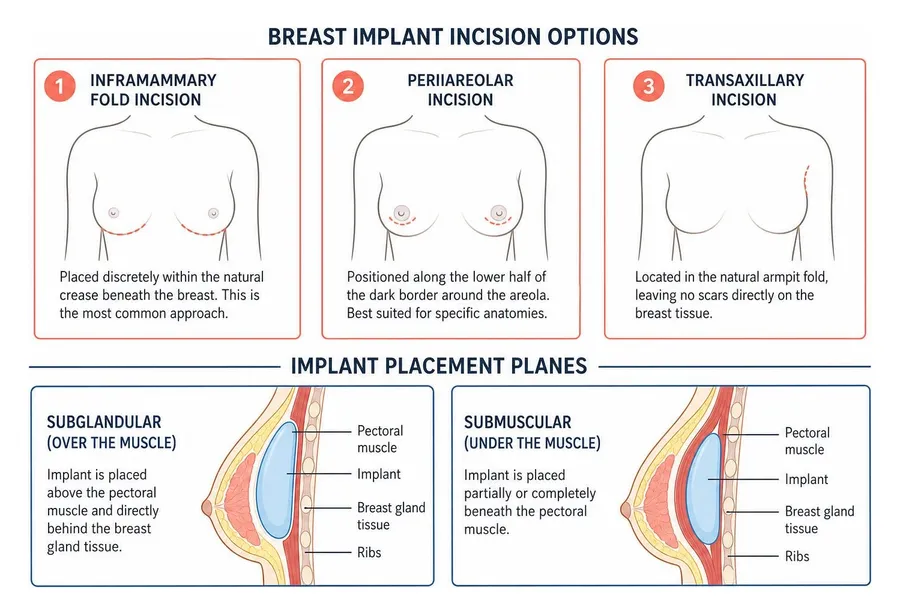
- Inframammary Fold Incision: Placed discretely within the natural crease beneath the breast. This is the most common approach because it provides direct visibility, precise pocket creation, and hides the resulting scar exceptionally well under natural breast tissue and swimwear.
- Periareolar Incision: Positioned along the lower half of the dark border surrounding the areola. While it conceals scars effectively on pigmented skin, it is best suited for specific anatomies and patients with adequately sized areolas.
- Transaxillary Incision: Located in the natural armpit fold, leaving no scars directly on the breast tissue. This approach is often paired with endoscopes to ensure precise pocket dissection.
Implants can be positioned in two primary planes:
- Submuscular (Under the Pectoral Muscle): Placing the device beneath the chest muscle provides additional soft tissue coverage over the upper pole of the implant. This approach creates a gentle, natural slope, softens implant edges on slender frames, and helps reduce the risk of capsular contracture.
- Subglandular (Above the Muscle, Under Breast Tissue): Positioning the implant directly behind the glandular tissue can provide efficient recovery and avoids muscle movement affecting the implant, making it a viable option for women with sufficient natural coverage and skin thickness.
Navigating Consultations and Recovery

Your private consultation is your opportunity to ask detailed questions, explore implant sizing, and build a trusting relationship with your care team. A thoughtful conversation about your goals, implant options, expected recovery, and individualized care plan can help you feel informed and comfortable as you consider your choices.
Questions to Ask Your Breast Augmentation Surgeon During Consultation
To get the most value out of your visit, consider bringing a written list of questions to discuss with your surgeon:
- Are you certified by the American Board of Plastic Surgery?
- Which incision and placement pocket do you recommend for my frame, and why?
- What implant size, profile, and cohesive fill will deliver the natural contour I want?
- What steps do you take in the operating room to support a smooth, well-planned procedure?
- How do you guide patients through healing and follow-up visits?
- What should I expect regarding recovery milestones, time away from work, and returning to exercise routines?
- Can I review before-and-after photos of patients with a starting body type similar to mine?
Recovery Timeline and Long-Term Results
Healing after breast surgery is a gradual, step-by-step process that rewards patience. While recovery experiences vary from patient to patient, here is a general timeline of what to expect during your recuperation:
- Days 1 to 3: Initial soreness and tightness across the chest are managed with prescribed medications and rest. You will wear a soft, supportive surgical bra around the clock to support healing tissue.
- Week 1: Most patients feel comfortable walking around the house, tapering off prescription pain medications, and attending their first postoperative checkup with the surgical team.
- Weeks 2 to 3: Light daily activities and desk work can usually resume. Gentle walking for light cardiovascular exercise is encouraged, while heavy lifting, pushing, and strenuous workouts remain restricted.
- Weeks 4 to 6: The implants begin to settle and drop into their natural pocket positions as muscle and breast tissue relax. You can gradually return to standard exercise routines as approved by your doctor.
- Months 6 to 12: Residual swelling resolves completely, incision scars soften and fade into natural skin creases, and the final breast contours emerge.
Your surgeon will recommend an appropriate follow-up plan based on your procedure, anatomy, and individual needs.
Frequently Asked Questions About Breast Augmentation
How do I know if I am a good candidate for breast augmentation?
Ideal candidates are non-smoking adults in good overall physical health who want to add volume, restore symmetry, or regain breast fullness lost after pregnancy or weight changes. Having realistic expectations, a positive mindset, and adequate skin elasticity is essential for achieving a smooth, natural outcome.
What is the typical recovery timeline after surgery?
Most women take roughly one week off from work and non-strenuous daily responsibilities. Light cardiovascular exercise like walking can start after two weeks, while upper-body lifting, vigorous workouts, and running are typically reintroduced after four to six weeks following clinical clearance.
How long do modern breast implants typically last?
Breast implants are durable medical devices, but they are not lifetime implants. While many modern cohesive silicone and saline implants last for ten to twenty years without issue, future maintenance or elective revision surgery may be desired down the road due to natural aging, weight shifts, or personal preferences.
Conclusion
Finding the right breast augmentation surgeon transforms your breast enhancement journey into a safe, empowering, and deeply satisfying experience. When you choose a provider who combines board-certified expertise with an artistic eye for proportion, you can achieve natural-looking contours that complement your lifestyle and silhouette.
At NorCal Plastic Surgery, Dr. Rankin works closely with patients across our SF Bay Area locations in Tiburon and Walnut Creek to design customized surgical plans. Whether you are seeking subtle enhancement or maternal restoration as part of a comprehensive mommy makeover, our team is dedicated to your safety, comfort, and aesthetic goals. If you are ready to explore your options, schedule a consultation with NorCal Plastic Surgery to take the first step toward lasting confidence.
References
Adams WP, Bravo FG, Calobrace MB, Cervantes A, Glicksman C, Layt C, Luan J, Triana L, Hedén P. "Drivers and Barriers of Breast Augmentation Surgery: Multinational Insights.." Aesthetic surgery journal. Open forum, 2025. PMCID PMC12709286.