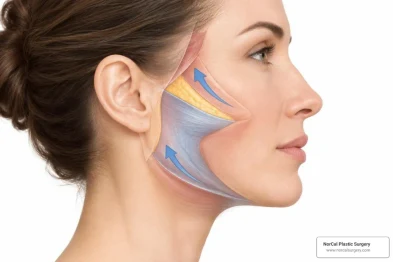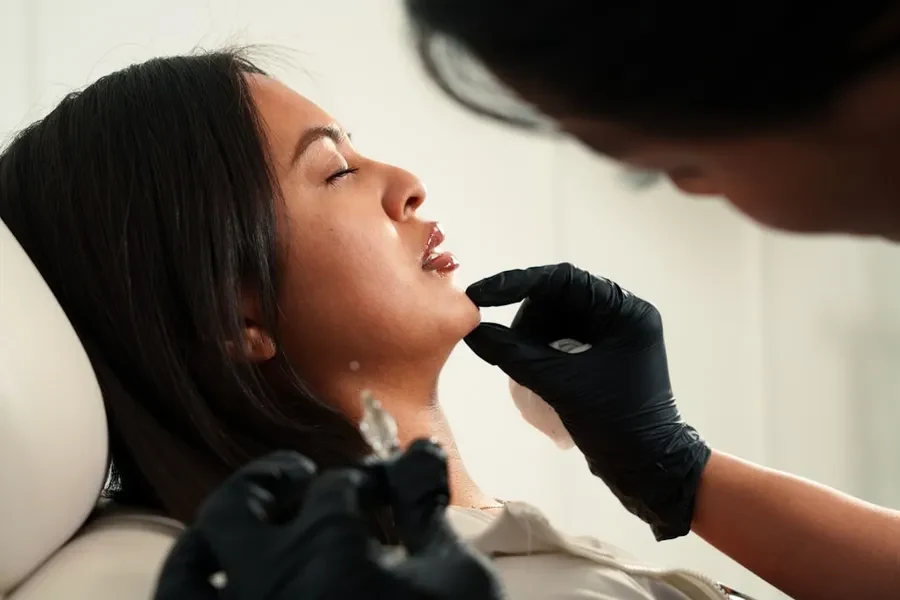
A facelift is designed to improve sagging in the cheeks, jawline, and often the neck. Today’s techniques focus on lifting the deeper support beneath the skin, not simply pulling the skin tight. The goal is a rested, natural-looking result. For a general overview of the procedure, see this facelift clinical overview.
Why the Face Changes Over Time
Several normal changes can make the face look less defined over time:
- Skin loses firmness: Skin becomes thinner and less elastic, which can contribute to looseness and wrinkles.
- Cheek fullness shifts lower: Volume that once sat higher in the cheeks can move downward, making folds around the mouth more noticeable.
- Deeper facial support relaxes: The layer that supports the cheeks and jawline can loosen, contributing to jowls.
- The neck changes too: Loose skin and muscle in the neck may soften the angle between the chin and neck.
These changes can lead to jowls, flatter-looking cheeks, deeper lines around the mouth, and loose skin beneath the chin.
What a Facelift Cannot Correct
A facelift improves sagging, but it does not address every sign of aging.
- Fine lines and skin texture: Treatments such as skincare, laser treatments, or other options may be better for fine wrinkles and rough texture.
- Sun spots and discoloration: Lifting the skin does not remove pigmentation or visible small blood vessels.
- Future aging: A facelift can provide long-lasting improvement, but the face continues to age naturally.
Some patients combine surgery with carefully chosen skin treatments for a more complete approach. Learn more about facial medspa treatments.
Facelift Options and Surgical Approaches
There is no one-size-fits-all facelift. At NorCal Plastic Surgery, the surgeon considers your facial shape, skin quality, amount of looseness, health history, and goals before recommending an approach.
SMAS and Deep Plane Facelifts
Both SMAS and deep plane techniques work below the skin to improve the cheeks, jawline, and neck. The difference is how the surgeon reaches and lifts the deeper facial tissue.
- SMAS facelift: The surgeon lifts and tightens a supportive layer beneath the skin. This can improve jowls, cheek position, and jawline definition.
- Deep plane facelift: The surgeon works beneath that support layer to lift the cheek and lower-face tissue together. This option may be considered when someone has more noticeable sagging through the cheeks and around the mouth.
The right technique depends on your anatomy, the amount of laxity, and what is safest and most appropriate for you. This overview of facelift surgery explains why treatment planning is individualized.
Mini-Facelift and Shorter Incisions
For mild to moderate looseness around the jawline, a smaller procedure may be an option.
- Mini-facelift: Uses shorter incisions and focuses mainly on early jowls and jawline definition.
A shorter-incision option may mean less extensive surgery and a quicker early recovery for the right patient.
Surgery Compared With Non-Surgical Treatments
Fillers, wrinkle relaxers, lasers, and skin-tightening treatments can help with certain concerns, but they do not replace a surgical facelift when there is significant sagging.
Some people also search for “non-surgical mommy makeover.” This is not one defined procedure. It usually refers to a personalized combination of non-surgical body contouring, skin tightening, injectables, medspa, or wellness treatments. It is not the same as a surgical mommy makeover or facial surgery.
| Treatment Feature | Surgical Facelift | Non-Surgical Treatments |
|---|---|---|
| Main purpose | Lifts deeper facial tissue and removes extra skin when needed | Adds volume, softens expression lines, or improves skin texture |
| Best for | More noticeable jowls, deeper folds, loose neck skin, and sagging cheeks | Fine lines, mild volume loss, uneven texture, and early skin looseness |
| Incisions | Yes, usually hidden near the hairline and ears | No surgical incisions |
| Anesthesia | Often general anesthesia or IV sedation | Usually topical numbing or local anesthetic |
| Downtime | Often around two weeks before many social activities | Usually little downtime, though redness or swelling can occur |
| How long results last | Often many years | Requires maintenance over time |
Who May Be a Candidate and What Surgery Involves

A good result starts with a careful consultation and thoughtful preparation.
Who May Be a Good Candidate
A person considering a facelift may be a good candidate if they have:
- Some skin elasticity, so the skin can settle smoothly after lifting.
- Noticeable looseness in the cheeks, jawline, or neck.
- Realistic expectations about what surgery can improve.
- Overall health that supports a safe procedure and recovery.
Your surgeon will also review factors that can raise the risk of complications.
- Nicotine use: Smoking, vaping, and other nicotine products can interfere with healing. Your surgical team will give you specific instructions about stopping nicotine before and after surgery.
- High blood pressure: Blood pressure should be well controlled before surgery because it can affect recovery.
- Blood-thinning medicines or bleeding conditions: These may increase bleeding risk and must be discussed with your medical and surgical teams.
Preparing for Surgery
Your instructions will be tailored to your health and procedure, but preparation often includes:
- Reviewing medications and supplements: Your team may ask you to stop certain products that can increase bleeding. Do not stop prescription medication without medical guidance.
- Completing medical clearance: You may need a health evaluation, blood work, or other testing before anesthesia.
- Following day-of-surgery instructions: This may include washing your hair and face as directed and not eating or drinking after the time provided by your team.
What Happens During a Facelift
A facelift is performed under anesthesia or sedation chosen for your treatment plan.
- Incisions: Incisions are usually placed near the hairline and natural curves of the ears so they are as discreet as possible. Neck treatment may require a small incision beneath the chin.
- Lifting and reshaping: The surgeon repositions the deeper facial tissue and, when needed, tightens the neck area.
- Closing the incisions: Skin is laid back gently without excessive tension, extra skin may be removed, and the incisions are closed. Small drains may sometimes be used briefly to reduce fluid buildup.
Facelift Recovery, Risks, and Lasting Results

Recovery is different for every patient, but knowing the usual stages can help you plan.
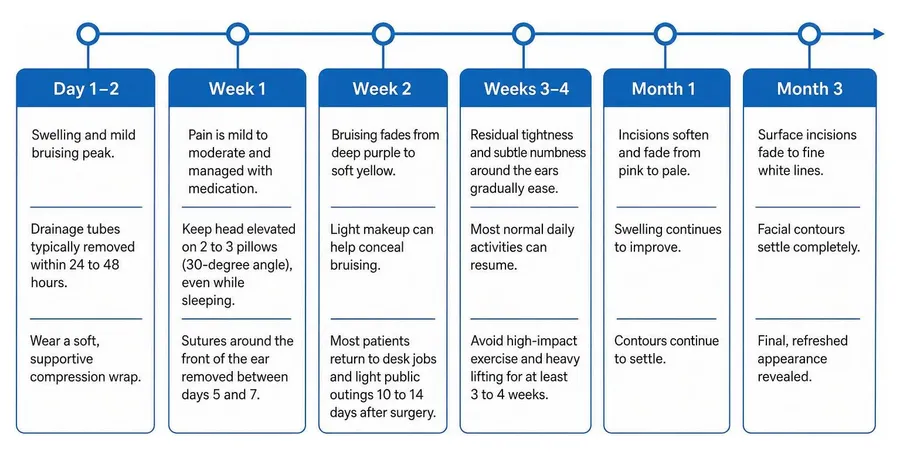
Typical Recovery Timeline
- First few days: Swelling and bruising are common. If drains are used, they are often removed within the first couple of days. You may wear a light support garment as directed.
- First week: Tightness, soreness, and fatigue are normal. Rest, keep your head elevated, and follow your surgeon’s instructions for medication and wound care. Some stitches may be removed during this period.
- Second week: Bruising and swelling often begin to improve. Many people feel ready for quiet social activities or desk work after about 10 to 14 days, depending on their recovery.
- Weeks three and four: Most daily activities can gradually resume. Your surgeon will tell you when it is safe to restart exercise and heavy lifting.
- Following months: Swelling continues to settle, scars mature, and the final shape becomes clearer.
How Long Does a Facelift Last?
A well-planned facelift can provide improvement that lasts for many years. Your results will continue to change naturally as you age.
You can support your result by:
- Wearing broad-spectrum sunscreen every day.
- Keeping your weight as stable as possible.
- Avoiding nicotine.
- Following a consistent skincare routine and your surgeon’s aftercare guidance.
Frequently Asked Questions

How long is facelift downtime?
Many people plan for about two weeks away from work and social events after a full facelift. A mini-facelift may have a shorter recovery, but the timing depends on the procedure and how you heal. Swelling and bruising usually improve steadily during the first two weeks.
Is recovery painful?
Most patients describe a feeling of tightness, pressure, or soreness rather than severe pain. Your surgical team will give you a plan for managing discomfort safely during the first few days.
What is the right age for a facelift?
There is no single right age. Many patients consider a facelift in their 40s, 50s, or 60s when loose skin, jowls, or neck changes become more noticeable. A consultation is the best way to determine whether surgery makes sense for your goals.
Conclusion
A modern facelift can improve sagging in the cheeks, jawline, and neck while preserving the features that make you look like yourself. The best approach is personal, based on your anatomy, goals, and safety needs.
At NorCal Plastic Surgery, board-certified plastic surgeon Dr. Timothy Rankin creates personalized facial surgery plans for patients throughout the Bay Area. Ready to learn whether a facelift may be right for you? Explore facial surgery options and schedule a private consultation.