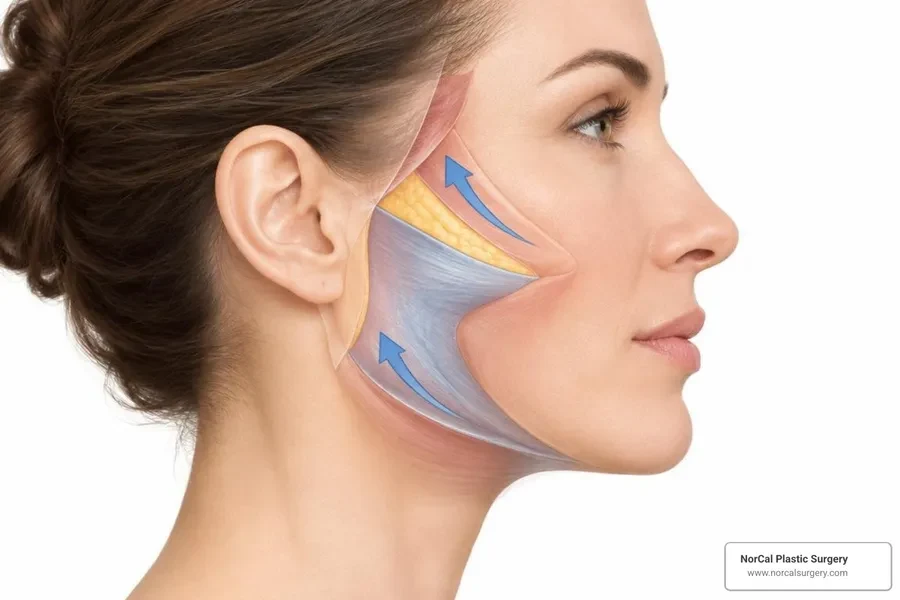
To understand why this technique has become a gold standard in modern facial rejuvenation, it helps to look beneath the surface of the skin. Traditional surgical methods historically focused on tightening the skin envelope alone. Over time, surgeons recognized that youthful facial anatomy is defined by deep volume support, not skin tension.
A deep plane approach operates in the anatomical space beneath the superficial musculoaponeurotic system, commonly known as the SMAS. During this procedure, the surgeon elevates a composite flap composed of both the skin and underlying fascia as a single, cohesive unit. Because the skin remains firmly attached to the deeper muscle and fat architecture, its natural blood supply remains intact.
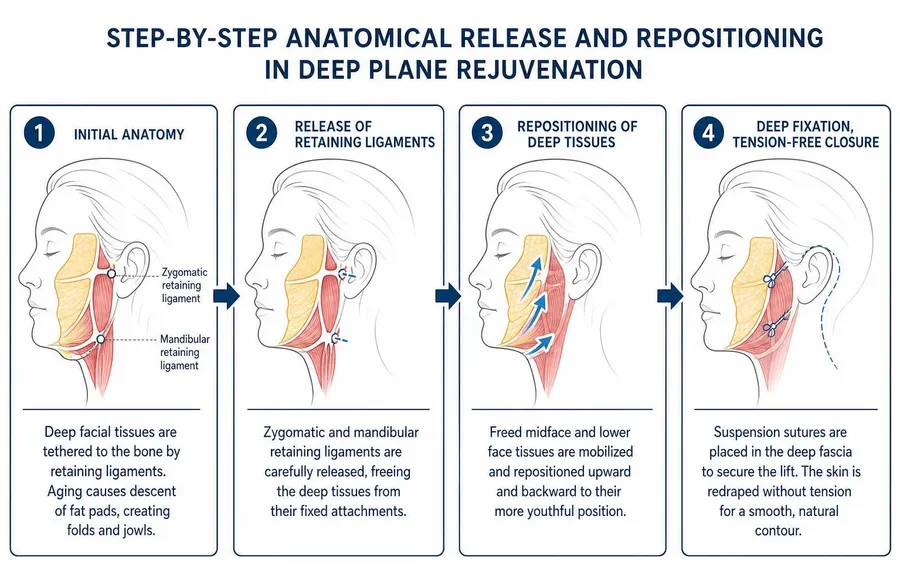
A central element of this method is the deliberate release of key retaining ligaments. These ligaments act like tiny anchor points that tether facial tissues to the underlying facial skeleton. As the face ages, the descent of fat pads pulls against these fixed anchors, creating prominent folds and jowls. By carefully releasing these ligaments, the surgeon can reposition descended midface fat pads without placing unnatural tension on the surface skin. Suspension sutures are placed within the deep fascia, enabling a tension-free skin closure. This anatomical concept is outlined in the clinical overview of deep plane facelift anatomy (Hohman et al., 2026).
Anatomical Advantages of a Deep Plane Facelift
The anatomical strengths of the deep plane approach center on structural mobility and flap health:
- Release of deep tethering: By addressing the zygomatic and mandibular retaining ligaments, tissues in the cheek and lower jawline can be repositioned more naturally.
- Malar fat pad repositioning: The descent of the cheek fat pad can deepen the nasolabial folds. Lifting this pad as part of the composite flap restores support to the high cheekbones without relying on excess fillers.
- Correction of jowls and buccal descent: Lower-cheek tissues can be repositioned to help restore a smoother, more defined jawline.
- Vertical vector of elevation: Rather than pulling tissues horizontally toward the ears, the deep plane technique allows a more vertical elevation vector, which mirrors the typical path of facial aging.
- Preserved vascularity: Maintaining the attachment between the skin and the SMAS protects the microvascular network, supporting healthy wound healing.
Who is the Ideal Candidate for a Deep Plane Facelift?
Every face ages at its own pace. The deep plane approach can be particularly beneficial for individuals experiencing moderate to advanced soft-tissue descent throughout the middle and lower thirds of the face.
You might be a candidate if you notice:
- Pronounced jowling that obscures jawline definition.
- Deep nasolabial folds and marionette lines extending toward the chin.
- Flattening of the midface and cheeks due to descent of the malar fat pad.
- Laxity in the upper neck and submental area that may benefit from structural repositioning.
- A desire for comprehensive structural change that avoids a tight or pulled appearance.
At NorCal Plastic Surgery, consultations are tailored to each patient's goals and anatomy to determine whether deep structural mobilization is appropriate. Patients throughout the Bay Area, including Walnut Creek and Tiburon, can explore customized facial rejuvenation options.
How SMAS Facelift Techniques Compare
SMAS-based procedures represent a major step forward from skin-only lifts and remain widely utilized in aesthetic surgery. Understanding how these approaches differ helps demystify the choices available to you.
In a traditional SMAS facelift, the surgeon elevates the skin separately from the underlying SMAS layer across a broader area. Once the skin is separated, the SMAS layer is addressed using one of two primary techniques:
- SMAS Plication: Folding the SMAS over itself and suturing it to create tension and lift.
- SMASectomy: Excising a small strip of the SMAS and suturing the edges together to tighten the layer.
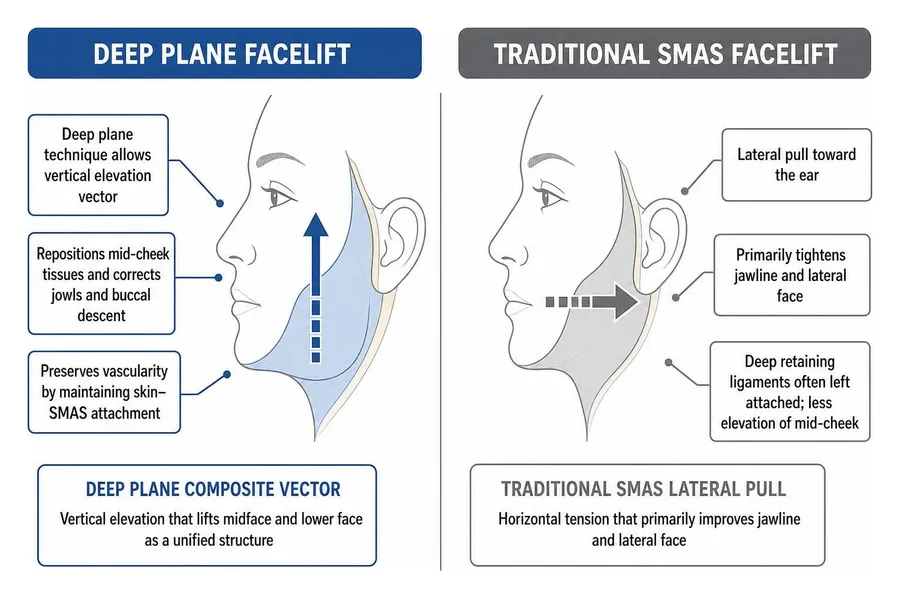
Both approaches tighten the lower face effectively. However, because the deep retaining ligaments of the cheek and midface are often left attached, the lift primarily affects the lower jawline and lateral face, rather than directly elevating the mid-cheek.
| Surgical Feature | Deep Plane Facelift | Traditional SMAS Facelift |
|---|---|---|
| Dissection Level | Beneath the SMAS layer (sub-SMAS) | Above the SMAS, separating skin from fascia |
| Flap Type | Composite (skin and SMAS together) | Layered (skin and SMAS handled separately) |
| Ligament Management | Direct release of retaining ligaments | Ligaments generally left intact |
| Midface & Cheek Elevation | Direct, vertical repositioning of malar pad | Limited midface mobility |
| Skin Tension | Low tension; anchored at deep fascia | Higher skin redraping tension |
| Vector of Lift | Vertical and oblique | Predominantly lateral (horizontal) |
Key Differences in Tissue Mobilization
The fundamental difference lies in how tissues move. In a SMAS lift, the intact retaining ligaments act as internal boundaries. When tension is applied to the SMAS or the skin, those anchors restrict the repositioning of the midface.
In contrast, entering the sub-SMAS space releases those anchor points. The cheek, jawline, and neck tissues move harmoniously as an integrated unit. This produces smooth transitions between facial zones and preserves animated, natural facial expressions when you smile, laugh, or speak.
Comparing Recovery and Longevity
Choosing a surgical path involves balancing recovery expectations with the type of change each technique can provide. Understanding the typical healing timeline helps patients plan with confidence.
Because a deep plane dissection keeps the skin and superficial tissue layers joined, the overlying skin retains its natural blood supply. This supports tissue viability and healing. In the early recovery period, patients can expect swelling and bruising that gradually improve as healing progresses. For deeper clinical insights, review this systematic review on deep plane facelift techniques.
A recent meta-analysis on deep plane facelift outcomes evaluated data across thousands of patients and found that deep plane procedures can provide durable aesthetic improvement when performed by an experienced surgeon.
Frequently Asked Questions About Advanced Facelift Procedures
How long do the results of a deep plane procedure last?
While no surgery stops the clock entirely, a deep plane facelift can provide long-lasting structural support. Because the deep retaining ligaments are released and the structural foundation is repositioned without skin tension, results often endure for a decade or more. Patients continue to age naturally from a refreshed starting point.
What is the typical downtime after modern facial rejuvenation surgery?
Most patients plan for roughly two weeks of social downtime. Bruising and visible swelling typically peak within the first few days and gradually diminish over the following two weeks. By the third week, many individuals feel comfortable returning to non-strenuous work and casual social outings. Light exercise is usually resumed around three to four weeks, while full, unrestricted activity follows after comprehensive tissue healing.
Can advanced facelift techniques be combined with other procedures?
Yes. Combining procedures can create a more balanced result during a single recovery period. Common complementary procedures include:
- Blepharoplasty (Eyelid Surgery): To remove excess upper eyelid skin and address lower eyelid puffiness.
- Neck Lift: To refine the submental contour and tighten platysma bands.
- Subnasal Lip Lift: To subtly shorten an elongated upper lip and enhance vermilion show.
- Autologous Fat Transfer: To restore micro-volume to delicate areas around the eyes and temples.
Conclusion
Facial rejuvenation is not about changing who you look like; it is about restoring harmony, contour, and balance. While both SMAS and deep plane techniques offer distinct merits, selecting the right surgical strategy depends on individual anatomy, soft-tissue mobility, and aesthetic goals.
Choosing a board-certified plastic surgeon with specialized experience in advanced facial techniques helps ensure that the procedure is planned with precision and safety at the forefront. At NorCal Plastic Surgery, patients throughout the Bay Area, Marin County, and the East Bay receive personalized treatment plans designed for natural-looking, enduring results.
Schedule a consultation to explore expert facial plastic surgery options.
References
Marc H. Hohman, Blake S. Raggio, Bhupendra C. Patel. "Deep Plane Facelift." StatPearls Publishing, 2026. NBK545277.